
Benidorm receives MedUX’s Digital Urban Connectivity Certificate: why connectivity is now part of destination experience

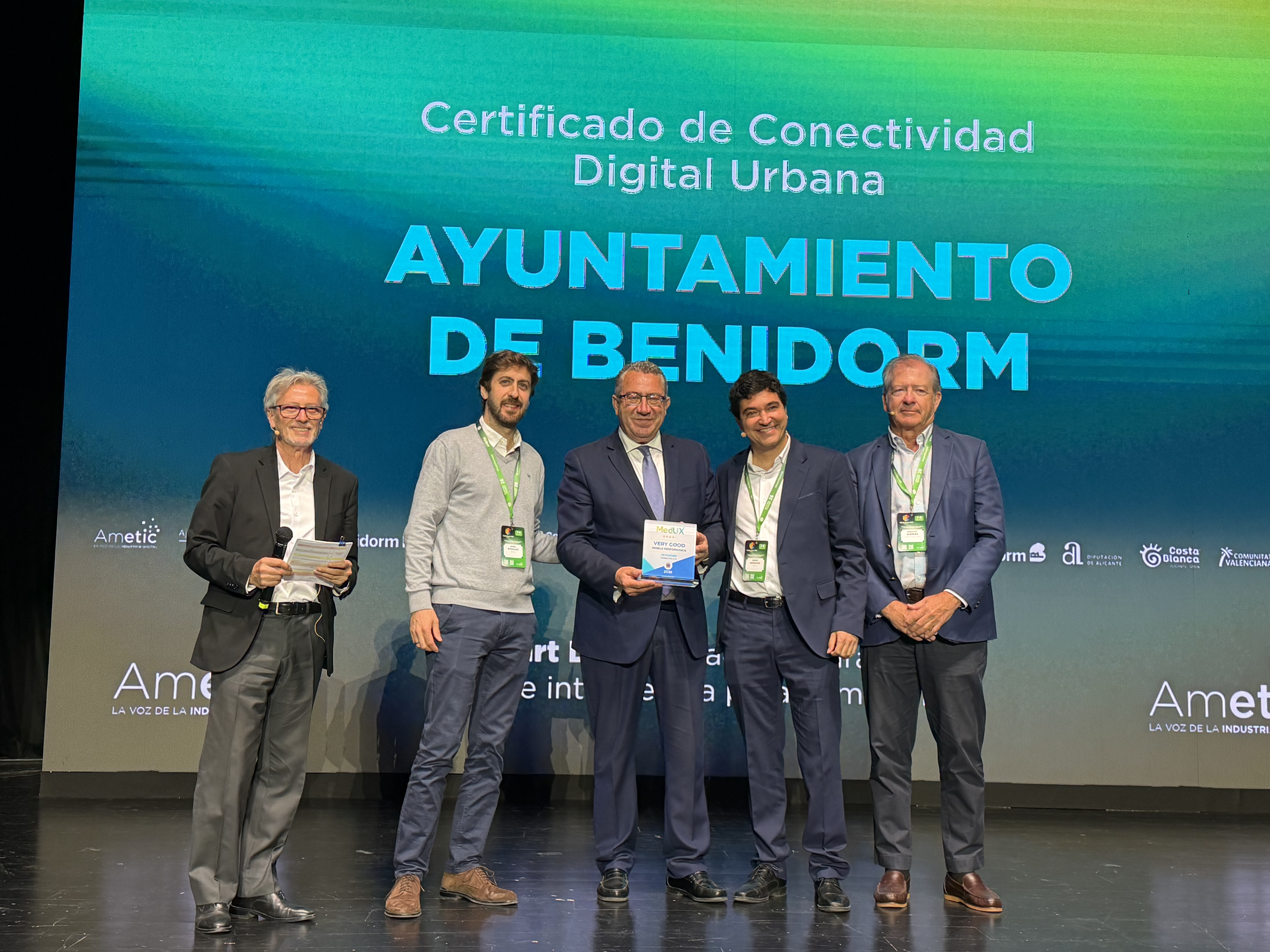
At Digital Tourist 2026 in Benidorm, MedUX presented the city with its first Digital Urban Connectivity Certificate, recognising an independently measured level of very good digital connectivity. The moment was covered locally as part of the event, reinforcing the growing relevance of connectivity within smart tourism and destination management.
This is not just a local milestone.
It reflects a broader shift that destinations, public institutions, and the tourism ecosystem increasingly need to address: connectivity is no longer just infrastructure in the background. It is part of the real experience people have in a place.
Destination experience is now digital experience
For years, connectivity could be treated as a technical layer: necessary, but secondary.
That is no longer the case.
Today, visitors rely on connectivity throughout their stay: to navigate, book, check in, pay, message, access public and private digital services, consume content, share experiences, and increasingly work remotely. When connectivity works well, the destination feels more seamless, more trustworthy, and more usable. When it fails, the problem is not only technical; it affects the visitor experience itself.
That is why the discussion around smart destinations is evolving. It is no longer enough to ask whether infrastructure exists on paper. The more relevant question is whether people can actually use digital services reliably and smoothly in real conditions.
Why objective connectivity measurement matters
In tourism, connectivity is often discussed indirectly.
Sometimes through user perception. Sometimes through isolated technical indicators. Sometimes through marketing claims that are difficult to compare.
Those signals are useful, but they are not enough if the goal is to manage, benchmark, improve, and eventually certify.
What destinations increasingly need is an objective, independent, and understandable way to evaluate real connectivity experience.
That is the logic behind the MedUX approach.
MedUX has spent years measuring real-world Quality of Experience, or QoE, through a multi-layer model that combines dedicated probes, large-scale crowdsourced measurements, Apps & SDK, and advanced analytics. Across fixed and mobile networks, MedUX helps operators, regulators, governments, and digital stakeholders move from fragmented KPIs to clear, comparable evidence of what users actually experience.
This same philosophy is what makes a destination-level conversation possible.
From measurements to a score decision-makers can use
One of the biggest barriers to turning connectivity into a destination KPI is complexity.
Real experience is multi-dimensional. It depends on responsiveness, reliability, throughput, service usability, and how common applications behave in real environments. That creates a large volume of data, but not necessarily a clear decision framework.
This is where the MedUX QoE Scoring methodology becomes relevant.
The scorecard aggregates multiple technical and service-level indicators into a single synthetic score while preserving drill-down capability underneath. In other words, it simplifies without becoming simplistic. It is designed to make benchmarking easier, enable prioritisation, and support decision-making across different stakeholders, from executives to technical teams.
MedUX describes this methodology publicly in line with ETSI TR 103 559 V1.2.1, and its ranking approach uses MOS concepts aligned with ETSI TR 103 559 V1.2.1 and ITU-T P.800.1.
That matters because if digital connectivity is going to become a recognised destination attribute, it needs to rest on methods that are transparent, robust, and aligned with international best practices.
Why Benidorm is a meaningful first case
Benidorm is not just any municipality in this story.
It is one of Spain's and the world's leading tourism destinations and a long-standing reference point in the smart destination conversation. Digital Tourist 2026 itself was positioned by AMETIC as a major forum for smart tourism, focused on digital infrastructure, data, AI and destination management.
That makes it especially relevant as the first municipality to receive this type of certificate from MedUX.
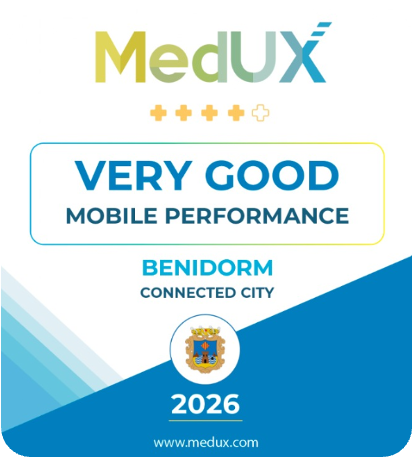
The certificate presented at Digital Tourist reflects a very good level of digital urban connectivity based on an independent assessment. And that threshold is not trivial. In MedUX’s latest European QoE benchmark, Spain recorded a mobile QoE score of 3.56 out of 5, while the leading countries in Europe ranged from 4.34 to 4.51. In that context, achieving a 4 out of 5 level is meaningfully above the broader national baseline and signals a strong digital experience.

So this is not simply about awarding a badge. It is about showing that a city can be assessed through a framework that is demanding enough to be credible and simple enough to be communicated.
Independent data helps separate deployment headlines from real experience
One reason this conversation is becoming more important is that connectivity narratives can sometimes move faster than user reality.
5G is a good example.
Recent MedUX benchmarking work shows that even in advanced regions, deployment headlines do not always translate into uniform everyday experience. In Europe, many large markets still show mixed 4G/5G realities, with strong urban 5G presence but uneven experience beyond hotspots. The benchmark also shows that Europe remains uneven in 5G usage and take-up despite strong progress in leading markets.
That is precisely why experience measurement matters: it helps reveal not just what has been deployed, but what is actually being used and felt by people.
The same logic applies to destinations.
For hotels, municipalities, and destination managers, the relevant question is not simply whether a network exists. It is whether the destination delivers reliable, usable, and competitive digital experience in practice.
A certificate should not end the conversation. It should start one
Perhaps the most important implication of the Benidorm milestone is that a certificate should not be seen only as recognition.
It should also be seen as a starting point for measurement, comparison, and continuous improvement.
That is why the conversation around digital urban connectivity should evolve in two directions at once: recognition, for destinations that already stand out; and improvement roadmaps, for destinations that want to understand where to act next.
In that sense, certification and intelligence are not separate ideas. They reinforce each other.
A credible destination-level framework should help answer both questions:
- How good is the experience today?
- What should be improved next?
From a first case to a broader framework
Benidorm’s certificate is a first step, but the significance goes beyond one municipality.
It points to a wider opportunity for the tourism ecosystem, public bodies, and standardisation stakeholders: to begin treating connectivity as a measurable part of destination competitiveness, digital service quality, and visitor experience.
This is also why the conversation at Digital Tourist felt timely.
What comes next
For MedUX, the Benidorm milestone reinforces a clear idea:
in smart destinations, connectivity is no longer just infrastructure: it is part of the real digital experience delivered to visitors, residents, and businesses.
And if that is true, then it makes sense to measure it, compare it, and improve it with the same seriousness applied to other strategic destination attributes.
Benidorm is the first municipality in this path.
It should not be the last.
About MedUX
At MedUX, we provide tools that help telecommunications regulators ensure that operators comply with Quality of Experience (QoE) and Quality of Service (QoS) standards for fixed, mobile, and digital services—based on real end-user data and insights. MedUX delivers a comprehensive view of the state and quality of digital services, as well as how they are perceived by end users.
MedUX offers innovative solutions for the telecommunications industry to tackle new challenges, enabling our clients to assess the quality of services provided, empower users, and meet regulatory requirements. If you'd like to learn more about our solutions, feel free to contact us at hello@medux.com.
Subscribe to our newsletter and stay up to date with our blog articles and more!
Don’t forget to follow us on social media and subscribe to our newsletter to receive the latest updates and news.
Follow us on:


Explore the Latest from MedUX

COVID-19 impact: Monitoring on European residential networks
This article is a compilation of our series of articles related to the state of residential fixed networks during the COVID-19 pandemic and how lockdown measures imposed by governments have impacted on the quality of experience and network performance in European households.
Broadband has…

MedUX 5G Report: Vodafone’s 5G 8x faster than 4G in Spain
MedUX is conducting walking and light drive tests to gain an independent view to find out about 5G data connectivity promises.
In the scope of this study, we measured 5G in strategic locations in Madrid: Puerta del Sol, Gran Vía, Glorieta Bilbao and Plaza de Colon. Our findings confirm…

MedUX reveals that Spain telecom providers offer outstanding User Experience in FTTH services
Spain is the leading country in fiber deployments in Europe, with a 33.9% of FTTH (Fiber To The Home) penetration rate, after joining around 1.61 million new subscribers between 2016 and 2017, according to a report commissioned by the FTTH European Council, formed by more than 150 companies. …