
CNMC 2026 Report: What It Reveals About Rural Mobile Quality, 5G and Real User Experience in Spain

The rural digital divide can no longer be understood through coverage alone.
Connectivity is now essential for working, studying, accessing public services, communicating and using digital content. As a result, the question has changed. It is no longer just whether a mobile network is available, but what kind of experience that network delivers in real conditions.
The CNMC report on the quality of telecommunications services provided to end users in rural areas compared with the rest of the country offers a detailed view of this shift. Its conclusions point to a clear trend: the territorial digital divide in Spain has narrowed, but differences remain in speed, access to advanced technologies and 5G deployment, especially in smaller municipalities.
The report also confirms that the rural connectivity challenge is becoming more complex. It is less about basic coverage and more about capacity, 5G availability, consistency across operators and the real performance of services such as web browsing, video streaming and voice.
That is where Drive Testing, Crowdsourcing and QoE analytics become especially relevant. Together, they help move the conversation from declared coverage to real user experience.
Why coverage is no longer enough to measure the rural digital divide
For years, rural connectivity has been discussed mainly in terms of network availability. But a network can be available and still deliver very different experiences depending on the technology deployed, the spectrum band used, network density, traffic load, device type or service being used.
This is why the value of the CNMC report lies as much in the methodology as in the results.
To analyze mobile quality, the CNMC combines two complementary approaches: controlled field measurements through Drive Testing and large-scale Crowdsourcing data collected from real user devices. This makes it possible to compare network performance under controlled conditions while also capturing what users experience in their daily lives.
In the mobile layer of the report, MedUX contributes two measurement components: the Drive Test campaign and the Crowdsourcing campaign. These two layers bring together a controlled view of network performance and large-scale field data from real terminals. The annex to the report states that both the Crowdsourcing campaign and the ad-hoc Drive Test campaign were awarded to CASE ON IT, S.L. – MedUX.
What Drive Testing and Crowdsourcing bring to mobile quality measurement
One of the strengths of the report is that it does not depend on a single source of information.
Drive Testing helps characterize the potential quality of mobile networks in controlled, reproducible and comparable conditions. Crowdsourcing, in contrast, captures the quality actually experienced by users in real environments, with the natural diversity of commercial devices, usage patterns, locations and network load.
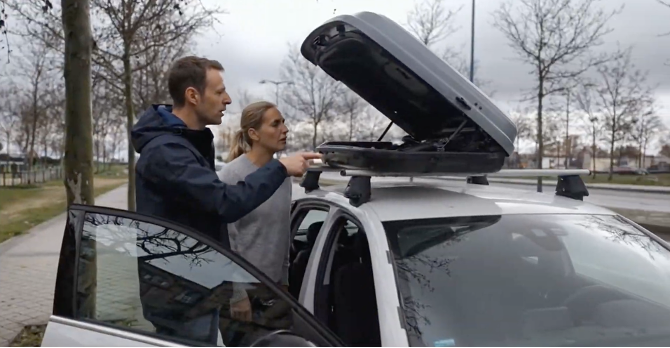
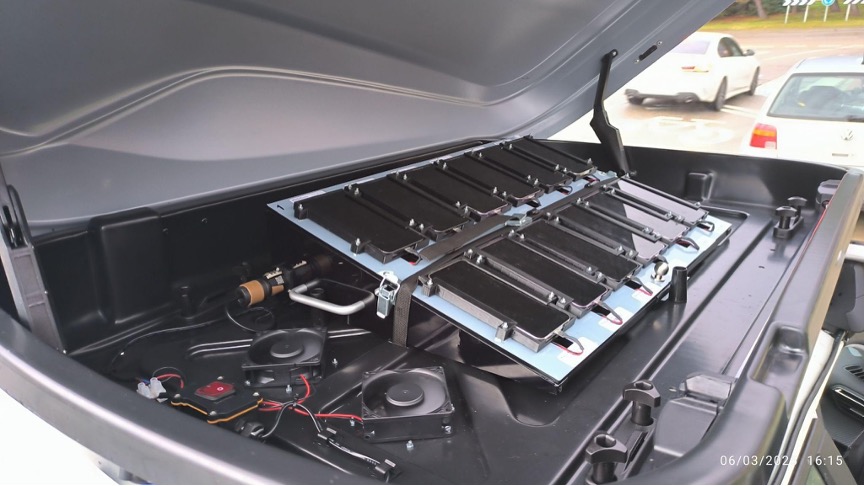
This distinction matters.
Controlled measurements are essential for comparing networks under equal conditions. Crowdsourcing adds scale and real-world context, showing how connectivity behaves across different places, times and user situations.
The Crowdsourcing campaign was designed as a complementary layer to the Drive Test measurements. It provides broader geographical and population representativeness and focuses on real usage conditions. The campaign used an SDK model integrated into everyday applications, with measurements running automatically in the background and without requiring explicit user action. This approach helps reduce bias linked to manual testing.
The campaign ran for six months, from April to September 2025, and collected data from 2,492,115 installations of the measurement software on user devices.
The Drive Test campaign, meanwhile, provides a controlled and traceable baseline. It was carried out between April and June 2025, with measurements in 993 municipalities, including 647 rural and 346 urban municipalities. It also covered roads, 6,870 grids and 21,670 kilometers of measured round-trip road length.
This combination allows the report to go beyond coverage maps and answer more relevant questions: where 5G is actually available, what capacity it delivers, how networks perform for browsing, video or voice, and where the most significant differences remain.
What the report says about rural 5G in Spain
Spain has a mature and widely deployed mobile network. 4G availability is almost universal, even in small municipalities, and radio quality remains solid across most of the country.
Still, the gap has not disappeared. It has changed.
5G is widely present, but deployment is not homogeneous. According to the crowdsourcing passive data collected in the report, 96% of the urban municipalities analyzed have at least one 5G network, compared with 83% of rural municipalities. The difference becomes more visible when looking at the availability of several 5G networks: 54% of urban municipalities have three 5G networks, compared with 18% of rural municipalities.
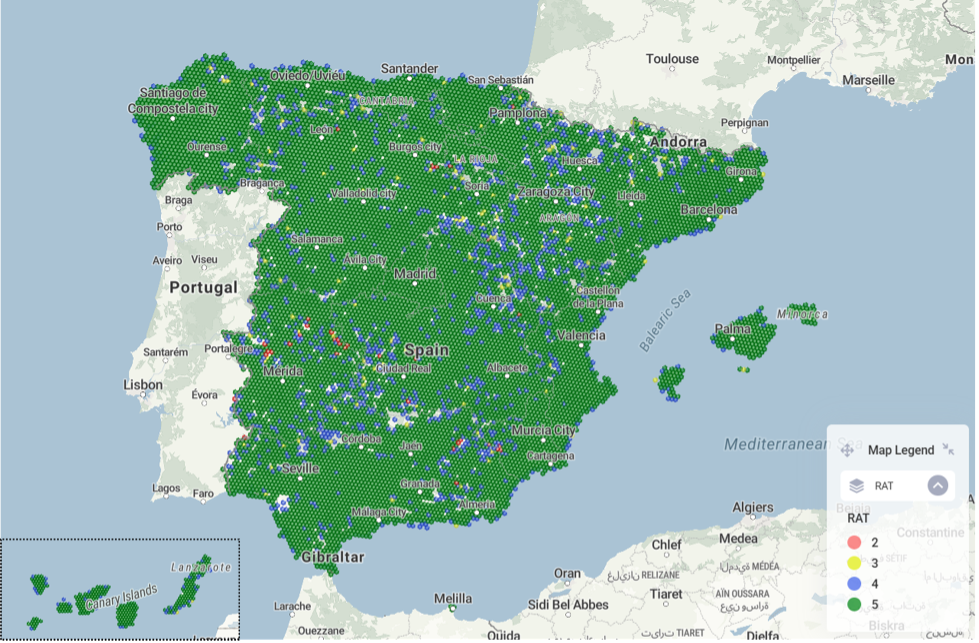
This points to an important lesson for network planning: basic coverage is no longer the only indicator that matters. The number of available networks, the predominant technology and the capacity delivered to the user are increasingly relevant for assessing Quality of Experience.
Speed shows the same pattern.
In download performance, rural areas reach an average speed of 86 Mbps, while urban areas reach 130 Mbps. The average value of the best network rises to 132 Mbps in rural areas and 198 Mbps in urban areas, which shows differences both between territories and between operators.
5G can help close this gap when it is deployed with enough capacity. In 5G, the average download speed measured through Drive Testing reaches 189 Mbps in rural areas and 271 Mbps in urban areas. However, when the analysis focuses on 5G in the 3.5 GHz band, average speeds are very similar: 457 Mbps in rural areas and 443 Mbps in urban areas.
This suggests that, where high-capacity 5G bands are deployed, the rural-urban gap can be reduced significantly.
The issue is therefore not just whether 5G is available. The real question is what type of 5G is available, in which bands, with what density and with what effective capacity for the end user.
Municipality size also matters
The report also shows that the rural-urban divide does not tell the whole story. Population size plays a major role.
Medium and large municipalities tend to show more consistent results. Smaller municipalities, on the other hand, concentrate more variability, lower speeds, wider differences between networks and lower availability of multiple 5G networks.
This matters for public policy, regulation and network planning.
National averages are useful, but they do not show where action is most needed. To identify priority areas, analysis must go down to the level of geotype, municipality, technology and service.
QoE and QoS analytics make that possible. They help identify which areas have lower capacity, where 5G is not yet delivering a clear improvement, which services are most affected and where the best-performing network shows that optimization is still possible.
User experience remains solid for everyday services
The report also looks at services that are close to the user’s daily experience, including web browsing, video streaming and voice calls.
For web browsing, average page load times are around 2.4 seconds in rural areas and 2.5 seconds in urban areas, with success rates above 95% in the reference scenario of four pages. This shows a robust experience for common browsing use cases.
For YouTube, the success rate reaches 100% in both rural and urban environments. Playback start times are almost identical, at 1.65 seconds in rural areas and 1.66 seconds in urban areas, with more than 94% of sessions reaching HD720 resolution or higher.
This is an important finding. Rural areas do not appear as disconnected territories or as areas with a generally poor mobile experience. The data shows solid mobile quality for many digital services.
The gap is more specific. It is concentrated in capacity, advanced 5G availability, smaller municipalities and differences between networks.
For many current digital services, the experience may already be sufficient. For new use cases, higher-quality video, immersive services, enterprise applications, advanced mobility or critical communications, capacity, low latency and consistency will become much more important.
How the MedUX QoE Suite turns measurement into decisions
The value of the report is not only the amount of data behind it. It is the ability to combine different measurement layers into a complete view of mobile quality.
MedUX Mobile and Drive Test methodologies enable controlled, reproducible and comparable measurements across operators, technologies and environments. This layer is especially useful for validating coverage, radio performance, speed, latency, browsing, video and voice under homogeneous testing conditions. MedUX Mobile is designed as a plug-and-play solution for mobile QoE testing, benchmarking and monitoring in 4G and 5G networks, in both static and mobility scenarios.
MedUX Crowdsourcing adds scale. It collects data directly from real user devices and helps show how networks perform in everyday conditions across different municipalities, technologies, devices and mobility contexts. Through active and passive measurements, it provides a broader view of network performance in the field.
MedUX Apps & SDK brings QoE measurement into existing applications. This enables more granular diagnostics, background measurements and a closer view of the experience users receive on their own devices, across cellular and Wi-Fi environments.
The analytics layer completes the picture. Advanced Analytics, Scorecard and MedUX Solve help transform millions of samples and technical KPIs into practical insights: which areas underperform, which technologies explain the differences, where investment should be prioritized and how network quality can be communicated to technical, executive and regulatory audiences.
This is the step that turns measurement into decision-making.
From data to regulatory intelligence
The CNMC report reflects a broader trend in telecom supervision: regulators increasingly need evidence based on real user experience.
Coverage maps remain necessary, but they are no longer enough. Two municipalities may have similar coverage and still deliver very different levels of speed, latency, video quality, browsing performance or voice reliability. The difference may depend on technology, spectrum, network density or the number of operators available.
Drive Testing, Crowdsourcing and advanced QoE analytics provide a more complete view of connectivity.
For regulators, this means stronger evidence to identify gaps, evaluate public policies, monitor market performance and improve transparency.
For operators, it means more precise information to prioritize investments, optimize deployments and demonstrate improvements with independent data.
For citizens, it means progress toward connectivity that is more comparable, transparent and aligned with their real needs.
Measuring better to close the digital divide more effectively
The CNMC report shows that Spain has made significant progress in mobile connectivity. 4G coverage is widely consolidated, 5G continues to expand and everyday mobile services generally perform well in both rural and urban environments.
But it also shows that the digital divide is evolving. It is no longer only about access or coverage. It is about capacity, quality, advanced technology availability, consistency across networks and the experience people receive when using digital services.
MedUX technology helps bring an independent, granular and data-driven view to this challenge. By combining controlled field measurements, large-scale user data, QoE testing and advanced analytics, MedUX helps transform network quality into regulatory and business intelligence.
Closing the digital divide is not only about deploying more network. It is also about measuring better, understanding where differences remain and acting where the data shows the greatest need.
That is the value of moving from declared coverage to real user experience.
Frequently Asked Questions About the CNMC Report and Rural Mobile Quality
What does the CNMC report on rural quality measure?
The report compares the quality of telecommunications services in rural and urban areas, including fixed services, mobile services, field measurements, large-scale user data and household perception.
Why is coverage alone not enough?
Because a network may be available but still deliver very different experiences in speed, latency, web browsing, video, calls or access to advanced technologies such as 5G.
What does Crowdsourcing bring to mobile network measurement?
Crowdsourcing makes it possible to observe real user experience at scale, using data from commercial devices under everyday usage conditions.
How does MedUX help regulators and operators?
MedUX combines Drive Testing, Crowdsourcing, Apps & SDK and QoE analytics to transform network and experience data into insights for supervision, benchmarking, planning and optimization.
About MedUX
At MedUX, we provide tools that help telecommunications regulators ensure that operators comply with Quality of Experience (QoE) and Quality of Service (QoS) standards for fixed, mobile, and digital services—based on real end-user data and insights. MedUX delivers a comprehensive view of the state and quality of digital services, as well as how they are perceived by end users.
MedUX offers innovative solutions for the telecommunications industry to tackle new challenges, enabling our clients to assess the quality of services provided, empower users, and meet regulatory requirements. If you'd like to learn more about our solutions, feel free to contact us at hello@medux.com.
Subscribe to our newsletter and stay up to date with our blog articles and more!
Don’t forget to follow us on social media and subscribe to our newsletter to receive the latest updates and news.
Follow us on:


Explore the Latest from MedUX

Hola España! Let’s analyze the connectivity gap between rural and urban areas
MedUX to conduct nationwide quality measurements following the awarding of the CNMC contract in Spain
In a strategic step towards improving telecommunications quality in Spain, MedUX has been selected by the National Commission on Markets and Competition (CNMC) to carry out an ambitious…