
Evidence that matters: the KPI layer MedUX brings to the Digital Networks Act

The Digital Networks Act (DNA) is the European Commission’s next major step to strengthen Europe’s connectivity framework—spanning investment, resilience, and Single Market rules. But as the DNA moves from policy intent to measurable outcomes, one question becomes decisive: how will Europe track progress in a way that reflects real user experience, not just coverage on paper?
In the DNA Impact Assessment, the Commission highlights exactly this gap and explicitly points to MedUX QoE benchmarking as supporting evidence, referencing MedUX’s “5G QoE Benchmark in Europe” (Q4 2024 drive testing, published at MWC25) and the “Status of 5G Quality and Experience in Europe” report prepared for the Commission with Q1 2025 data (Appendix II B).
This is more than a mention. It signals a shift in what will count as “progress” under DNA: KPIs that capture the lived network experience, where users actually connect, which 5G layers they truly use (mid-band, SA), and how digital services performance compares across countries and cities.

Coverage on paper vs. experience in practice: the KPI gap
The Commission’s assessment draws attention to a persistent reality: even where 5G is widely reported as deployed, end-users may still spend a meaningful portion of time on legacy access. MedUX QoE evidence shows that in Q4 2024, users in major EU cities still connect to 4G for 25% of the time on average, and that some cities lagged in mid-band 5G deployments while certain networks did not deliver the promised speed and advantages.
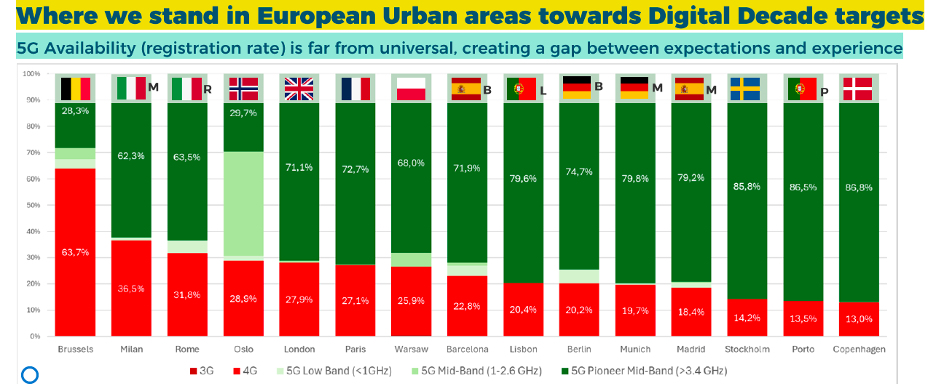
From a policy perspective, this matters because it reframes “coverage” into an outcome KPI that is much closer to what citizens and enterprises feel: fallback and consistency. If a city is “covered” but devices frequently revert to 4G, the DNA’s ambitions, especially around advanced 5G services, risk remaining theoretical.
What MedUX adds to DNA: a KPI set that measures high-quality 5G in reality
The Impact Assessment uses MedUX data to validate the Commission’s broader concern: Europe is lagging not only in “having 5G,” but in progressing to high-quality 5G, specifically the capacity and capability layers that enable next-generation services.
First, MedUX QoE data shows that across EU Member States, 5G availability (any type of 5G) stood at 46.6% based on end-user experience (5G devices only). This figure is crucial because it is not a marketing claim or population headline. It reflects what 5G-ready users actually experience.
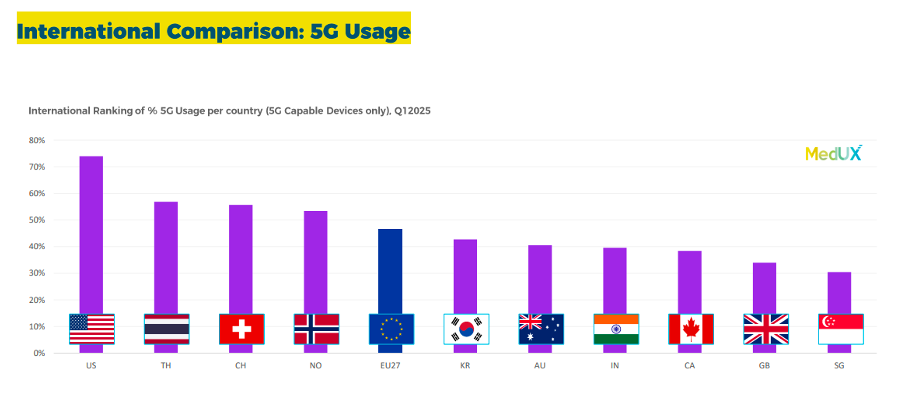
Second, within those 5G connections, MedUX evidence shows that deployments relying on mid-band (3.4–3.8 GHz) have reached approximately 57.2% of 5G usage in the EU27, versus 67.6% at the international level. Yet, and this is the nuance DNA tracking needs, when looking across all technologies, end-users in the EU are connected to mid-band only around 27.1% of the time. In other words: even where mid-band exists, it does not automatically translate into sustained user exposure to the capacity layer.
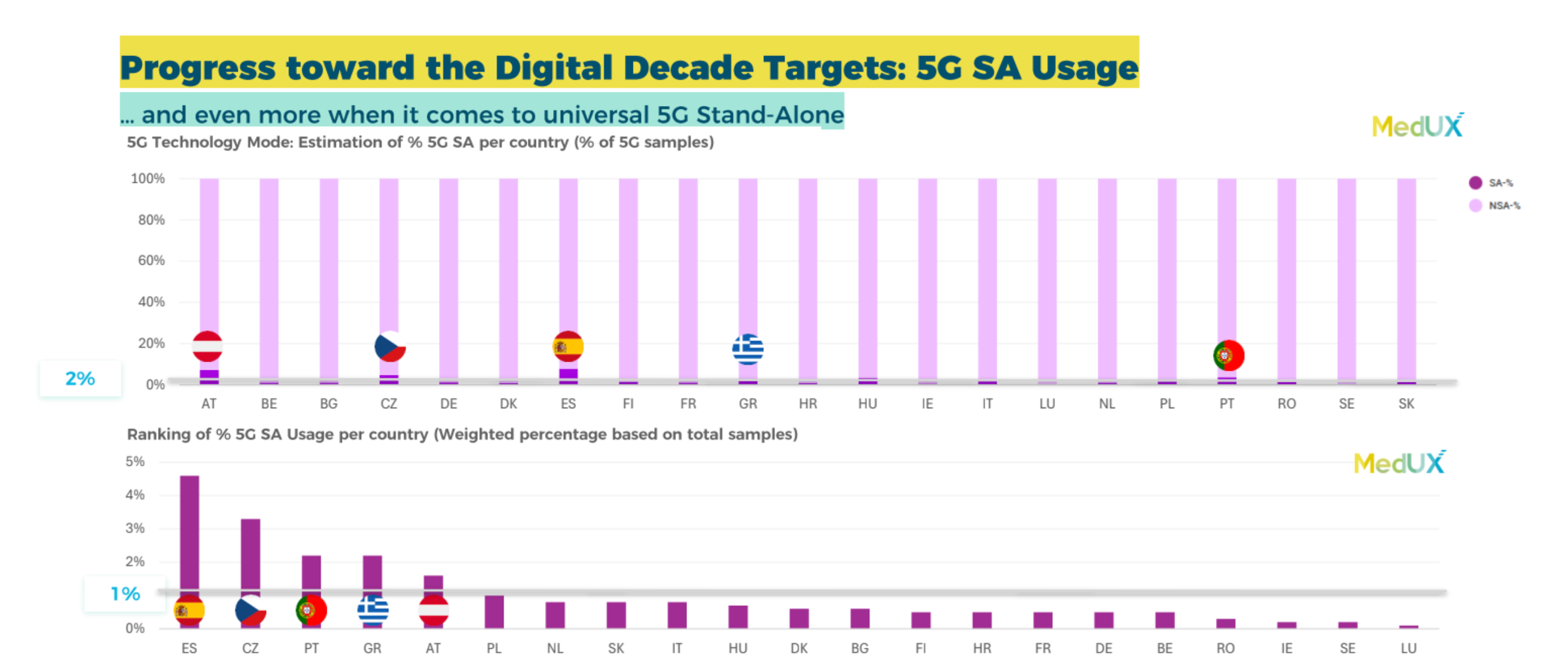
Third, MedUX QoE data highlights the most critical capability gap: 5G Standalone (SA). The Commission references MedUX evidence showing that in the EU27, less than 2.5% of 5G connections are on SA, and when considering all access technologies, SA accounts for only 1.2% of usage, reflecting that most European operators remain in the 5G Non-Standalone phase. This is precisely the layer that underpins many of the advanced use cases associated with 5G’s strategic value.
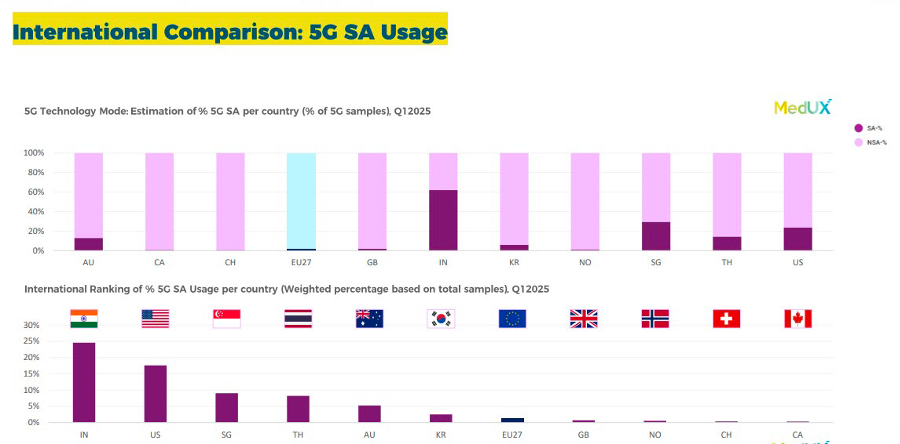
To put the gap into global context (also through the same MedUX-referenced section), the Commission notes that internationally, specific leading markets record 25% SA usage (India) and 18% (US) when considering all access technologies. These comparisons matter because DNA is ultimately about Europe’s competitiveness: the relevant KPI is not “Do we have 5G?” but “Are users actually benefiting from the advanced 5G layer?”
Experience KPIs that are comparable across countries and cities
The DNA is a Single Market initiative. That means progress cannot be tracked in ways that are not comparable across borders and geographies. The Commission uses MedUXsupported evidence to show that Europe still trails on performance outcomes: EU27 average download speed is 69.9 Mbps, below South Korea (162.2 Mbps), Norway (133.3 Mbps), the US (129.3 Mbps), and China (100 Mbps)—and slightly below the global average (70.4 Mbps).
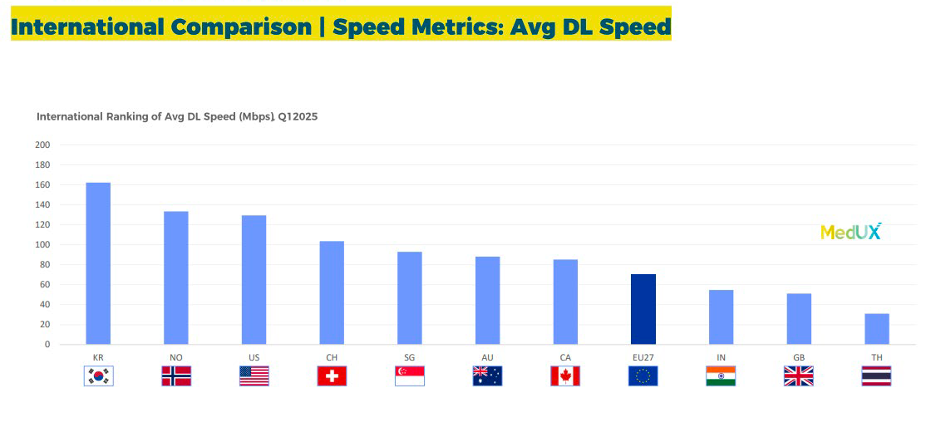
Speed alone is not QoE, but as a policy KPI it provides a consistent baseline signal of whether the capacity layer is materializing in real user outcomes. When combined with the experience KPIs above, fallback, time-on-mid-band, and SA share, it becomes possible to identify why performance differs across cities and countries, and what levers (spectrum layer, densification, SA migration) need to accelerate.
Why this matters now: DNA targets need “decision KPIs”
The Commission’s reference to MedUX is, in practice, a reference to a measurement philosophy: track progress where it matters to users. That means shifting from static deployment reporting towards a compact set of decision KPIs that regulators, operators, and policymakers can use to validate outcomes, benchmark performance, and prioritize investment.
The MedUX evidence cited in the Impact Assessment naturally maps into a “DNA-ready” KPI layer: how often users still rely on 4G in key cities (fallback), what portion of 5G-ready users actually experience 5G (experience-based availability/usage), how much of that experience is delivered through mid-band (capacity layer), and whether SA is becoming meaningful in real usage (capability layer).
Beyond the Q4 2024 drive-testing benchmark, the Commission also references MedUX’s complementary Q1 2025 dataset in the “Status of 5G Quality and Experience in Europe” report prepared for the EC, reflecting large-scale end-user experience insights (including crowdsourcing-based inputs) designed to support comparable monitoring.
MedUX Impact: Transforming Connectivity into a Cornerstone of Progress
By focusing on user-centric QoE and the capacity/capability layers of 5G, the evidence cited in the DNA Impact Assessment is more than just a measurement of network performance. It aligns directly with the MedUX Impact vision: transforming connectivity from a technology goal into a cornerstone of societal progress. Our work supports policymakers and operators in bridging the digital divide, building resilient infrastructure, and ensuring that advanced digital experiences are accessible, high-quality, and ultimately contribute meaningfully to a sustainable, inclusive future for all.
Closing: building a measurable path from policy to user outcomes
If DNA is to deliver on its promise, the industry needs KPIs that make progress visible at the user laye: consistent, comparable, and actionable. The Commission’s reliance on MedUX QoE evidence reinforces that direction: coverage on paper is no longer enough; what matters is whether citizens and enterprises experience the performance and capability layers that define high-quality 5G.
At MedUX, we will continue working with regulators and operators to provide the evidence layer needed to track DNA outcomes across countries and cities, across technologies, and across the services users actually consume.
If you’d like to explore how MedUX can support DNA-aligned KPI tracking, from benchmarking to continuous QoE monitoring, our team is ready to help.
Don’t forget to follow us on social media and subscribe to our newsletter to receive the latest updates and news.
Follow us on:


About MedUX
MedUX is the leading Quality of Experience (QoE) company, providing comprehensive and innovative solutions for measuring the performance of fixed, mobile, and TV telecommunications networks for telecom operators, governments, and digital enterprises. With a focus on delivering grand scale, end-to-end network, and service visibility, MedUX leverages real-time customer perspective data and advanced analytics to ensure quality and regulatory compliance, while also offering valuable insights for optimizing networks and improving customer experiences. With a presence in over 25 countries across Europe, America, Africa, and the Middle East, and monitoring over 60 operators worldwide, MedUX’s patented technology and expertise make it a trusted partner for improving the digital experiences of customers everywhere.