
Yettel edges Telekom at the top of the Hungarian mobile experience

Telekom records the most 5G of the three and the highest share of 4K video, and takes Streaming and Social Media. The quarter still goes to Yettel, by 0.05 points out of five, with One a long way behind both.
MedUX's Q3 2026 Mobile Network Experience Benchmark in Hungary is an independent assessment of Yettel, Telekom and One that goes beyond traditional speed metrics, using crowdsourcing measurements from real-user devices.
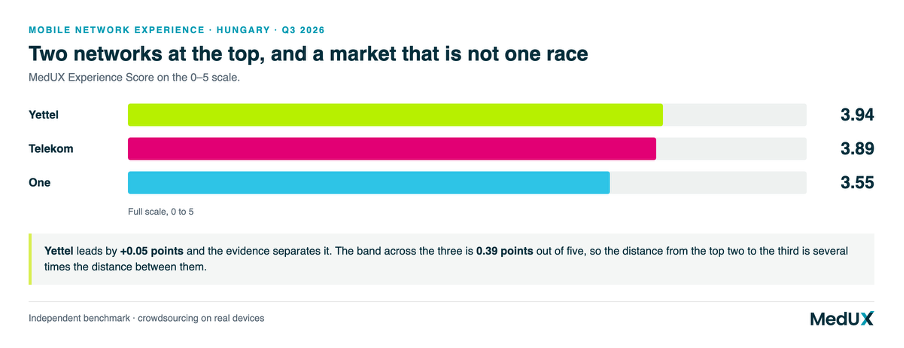
The benchmark identifies Yettel as the statistically differentiated leader in overall experience, with a MedUX Experience Score of 3.94 out of 5. Telekom scores 3.89 and One 3.55.
What separates Yettel from Telekom in Hungary
Yettel's advantage over the next operator is +0.05 points out of five, and it is not made of one thing. The overall score combines four scoring dimensions that do not carry the same weight, so the margin inside a dimension and what that dimension moves in the total are not the same size. Yettel is ahead of Telekom in Value for Speed and in Accessibility, and behind in Streaming and in Data & OTT.
Yettel's clearest gain is Value for Speed, where it leads by +0.32. It is also ahead of Telekom in Accessibility, the dimension built on latency, where Telekom is the weakest of the three. Telekom answers in Streaming, where it leads by +0.22, and in Data & OTT, where it is 0.05 ahead. The four movements run in opposite directions and most of them cancel, which is how margins of that size resolve into a lead of +0.05. MedUX recognises a differentiated leader only when its advantage over every relevant competitor is supported at the 95% confidence level, and that lead meets the test.
Yettel leads Hungary on consistency, Telekom on video
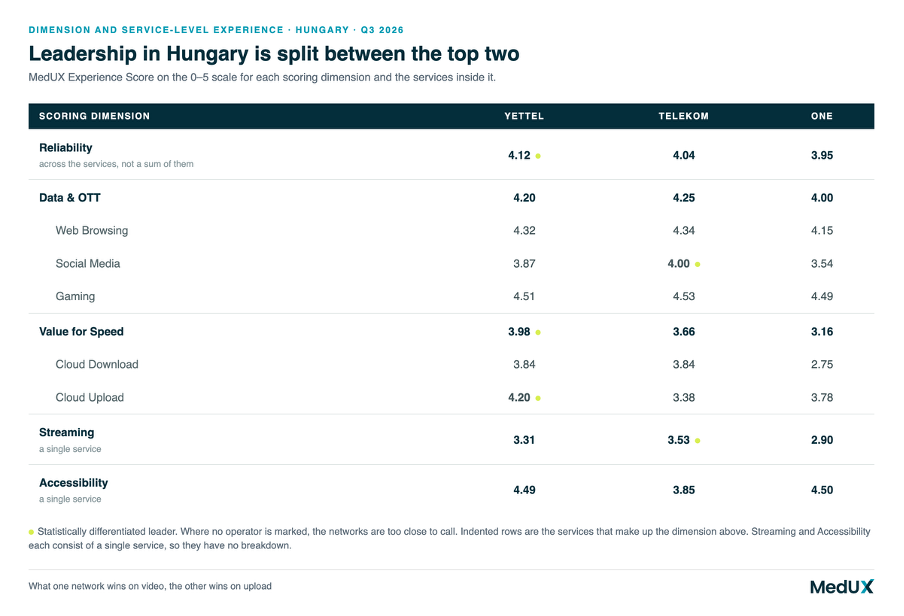
Yettel is the differentiated leader in the overall score, in Reliability and in Value for Speed, and at service level in Cloud Upload. Telekom is the differentiated leader in Streaming and in Social Media. One is not separated as a leader anywhere.
Differentiated leadership appears in four of the six scoring dimensions and three of the six services, and it is shared between the two networks at the top. Accessibility and Data & OTT are too close to call.
Telekom holds the market's capacity headline. It records the highest share of measurements on 5G of the three, and the highest share of playbacks served in 4K, 54.7%. Neither converts into the overall lead.
What it does not hold is the clock. Its mean observed latency is 52.7 ms against 24.6 ms for Yettel and 24.4 ms for One, and the dimension built on latency puts it a long way behind both.
Which services separate Yettel, Telekom and One
Not every service separates the networks by the same distance, and where they do separate, the leader is not the same one.
The widest margin over the next operator in a single service appears in Cloud Upload (+0.42), where Yettel is the differentiated leader, followed by Streaming (+0.22), where Telekom is. The narrowest is Cloud Download, where Telekom and Yettel record the same score to two decimals, so no leader is recorded there. Web Browsing and Gaming are the same case.
Video shows the same thing from another angle. The share of playbacks served in 4K ranges from 54.7% to 32.4%, and this time the network serving the highest share is also the recognised leader in Streaming. A stream is still judged by how quickly it starts and whether it stops, not only by the resolution it reaches.
Yettel matches Telekom's 5G speed with a quarter less 5G
Capacity still matters, but it does not settle the experience on its own. Hungary shows why.
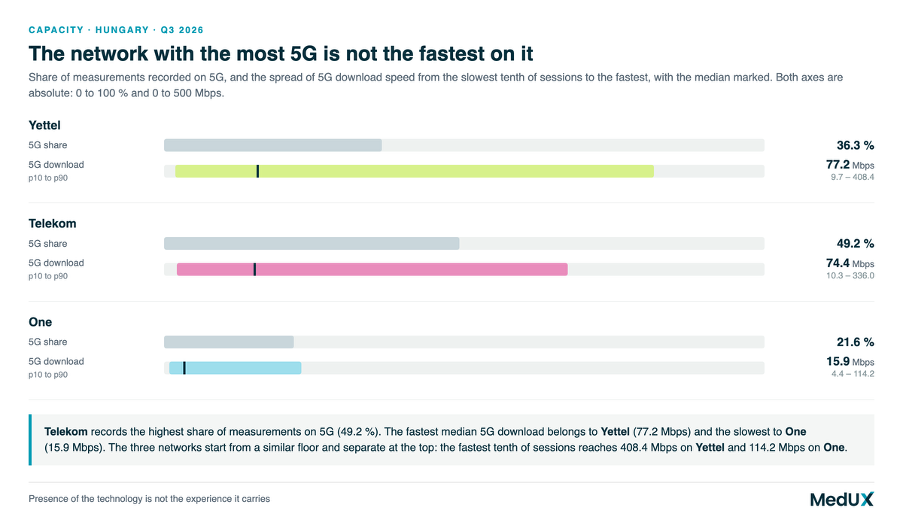
Telekom records the highest share of measurements on 5G, 49.2% of its tests, and a median 5G download of 74.4 Mbps. Yettel, on a share of 36.3%, reaches 77.2 Mbps. Greater observed 5G presence does not translate into faster downloads.
Restricted to handsets that support 5G, the shares rise to between 34.8% and 73.5%. The first figure describes composition, shaped by the network and by the device mix alike. The second isolates the network from the device mix, and the order does not change.
Moving from 4G to 5G multiplies the median download by between 1.6 and 2.8 times, depending on the operator. The step is wide on the two networks at the top and narrow on the third, which is where the capacity gap in this market lives.
How MedUX measured the Hungarian mobile experience
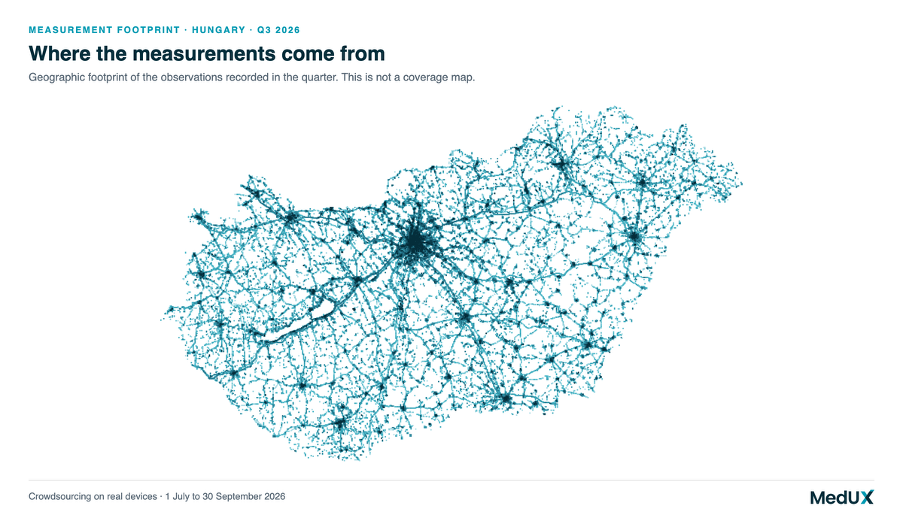
The benchmark draws on 1,030,696 active measurements and more than 85 million passive radio samples collected from 1 July to 30 September 2026 through MedUX crowdsourcing on real-user devices. Active measurements were taken on each operator's own SIM and mobile network. Wi-Fi and roaming sessions were excluded. Radio samples provide network context and quality control and do not enter the Experience Score. Speed figures in this article are medians and percentiles, standardised geographically.
Three networks are assessed because three is what the Hungarian market has. Yettel, Telekom and One each run their own radio network, and all three meet MedUX's predefined requirements for data quality, geographic support and statistical sufficiency in the period. That criterion is evaluated on the crowdsourcing measurement itself.
Results are then standardised geographically against the Eurostat Census 2021 population grid (1 km²) through a hierarchical estimator, with regions assigned on NUTS2 2021 GISCO polygons. The figures therefore describe the market rather than the places where measurement happens to concentrate.
MedUX translates technical KPIs into service-specific experience scores that reflect both whether a task completes adequately and the quality delivered. This approach prevents exceptional peak performance from masking an inconsistent service experience.
The results describe experience in the observed measurement footprint. They are not a coverage or network-availability assessment.
Why MedUX scores Hungary service by service
Quality of Service metrics such as throughput and latency remain essential, but they do not explain the full customer experience.
Mobile users experience networks through applications and services, from watching video and browsing to gaming, social media and cloud platforms. The Hungarian results show why a single network indicator is not enough. The operator with the most 5G does not have the fastest 5G, and the operator serving the highest share of 4K playbacks is not the one with the best overall experience.
That is why MedUX combines network-performance indicators with service-level QoE metrics and a common scoring framework, applied equivalently to every operator evaluated. MedUX acts as an independent third party and neither manufactures nor sells mobile network infrastructure.
See the full Hungary Q3 2026 results
Explore the Hungary Q3 2026 Mobile Network Experience Snapshot for a visual overview of the experience scoring, results by service, statistical leadership and the geographic measurement footprint.
The snapshot includes:
- The national MedUX Experience Score and its statistical status.
- The full experience scoring by dimension.
- Service-level results for streaming, web browsing, social media, gaming and cloud.
- What each dimension measures.
- The measurement footprint of the period.
- Scope, method and the criterion applied for statistical leadership.
Download the Hungary Q3 2026 Mobile Network Experience Snapshot
Methodology
For more information on MedUX's approach to mobile crowdsourcing and service-level QoE benchmarking:
Explore MedUX's Mobile QoE Crowdsourcing Benchmarking Methodology
The Hungary Q3 2026 benchmark applies version 2026.1 of that methodology, which takes as its reference the good practice set out in ETSI TR 103 559.
Don’t forget to follow us on social media and subscribe to our newsletter to receive the latest updates and news.
Follow us on:


About MedUX
MedUX is the leading Quality of Experience (QoE) company, providing comprehensive and innovative solutions for measuring the performance of fixed, mobile, and TV telecommunications networks for telecom operators, governments, and digital enterprises.
With a focus on delivering grand scale, end-to-end network, and service visibility, MedUX leverages real-time customer perspective data and advanced analytics to ensure quality and regulatory compliance, while also offering valuable insights for optimizing networks and improving customer experiences.
With a presence in over 50 countries across Europe, America, Africa, and the Middle East, and monitoring over 100 operators worldwide, MedUX's patented technology and expertise make it a trusted partner for improving the digital experiences of customers everywhere.