
KPN and Odido reach the top of the Dutch mobile experience by opposite routes

What happens when two mobile operators achieve similar overall experience scores, but stand out in different services?
MedUX's Q3 2026 Mobile Network Experience Benchmark in the Netherlands reveals a highly competitive market: KPN and Odido achieve similar overall scores but show different strengths across Quality of Experience (QoE) dimensions and services. Based on crowdsourcing measurements from real-user devices, the study evaluates KPN, Odido and Vodafone beyond traditional speed metrics.
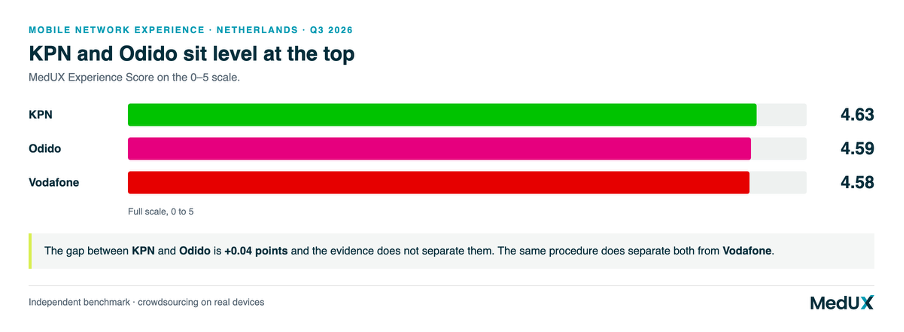
The Q3 2026 benchmark does not identify a statistically differentiated overall leader. KPN scores 4.63 out of 5 and Odido 4.59, a difference of +0.04 points that is not statistically conclusive. The report also identifies Vodafone, at 4.58, as statistically behind both operators.
The three operators evaluated therefore sit within a band of 0.05 points out of five. In a market this tight, the useful question is not who comes first on the headline figure, but where each network is genuinely differentiated.
A tie is a result, not a missing verdict
A benchmark without a unique overall leader still delivers a clear result. It distinguishes numerical differences from advantages supported by statistical evidence.
MedUX recognises a differentiated leader only when its advantage over every relevant competitor is supported at the 95% confidence level. KPN's +0.04-point overall advantage over Odido is not statistically conclusive, while KPN's advantage in Accessibility and Reliability is. This distinction makes the benchmark more meaningful than a simple ranking of scores.
Two routes to the same score
The absence of a differentiated overall leader does not mean that the networks perform identically. KPN and Odido show distinct strengths across the services and dimensions evaluated.
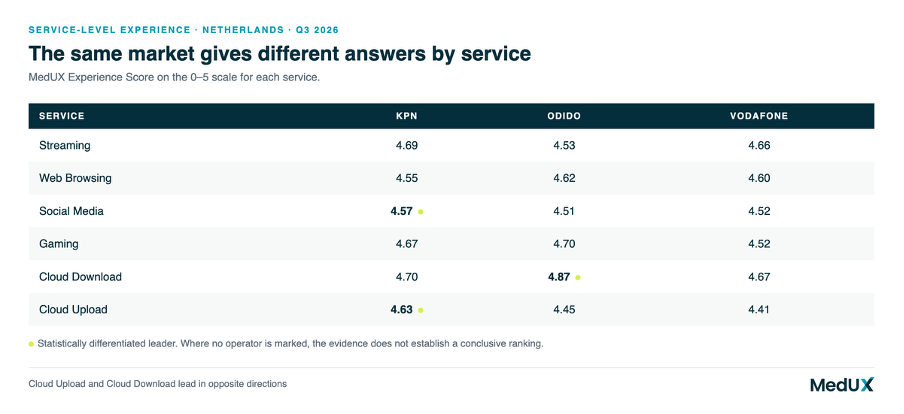
KPN stands out in consistency and responsiveness. It is the statistically differentiated leader in Reliability (4.65) and Accessibility (4.55), reflecting the ability to complete network tasks consistently and access services with adequate response times. At service level, KPN also leads Social Media and Cloud Upload.
Odido stands out in Cloud Download, where it achieves a score of 4.87, the highest individual service score in the benchmark. It also leads the separate measured-speed comparisons for overall download and upload, as well as 5G download. The 5G upload comparison is not statistically conclusive.
Vodafone is not a differentiated leader in any dimension or service during the period, even though it records the highest share of measurements on 5G.
These contrasting strengths help explain why the overall evidence does not distinguish a unique leader between KPN and Odido. The results are more informative when viewed by service and experience dimension rather than as a simple numerical ranking.
Differentiated leadership appears in two of the five experience dimensions and three of the six services evaluated. The overall MedUX Experience Score is reported separately.
Service experience: the same market, different answers
The differences vary materially from one service to another, and they do not all point the same way.
Cloud Upload and Cloud Download show two of the widest service-level differences, with statistically differentiated leaders in opposite directions: KPN for upload and Odido for download. The Cloud Upload lead is +0.18 points on the published scoring scale. Web Browsing is much more closely grouped, with a +0.02-point difference between the two highest scores and no conclusive leader.
Video provides another example. The observed share of playbacks served in 4K ranges from 75.6% to 80.1%, with KPN recording the lowest share but the highest numerical Streaming score (4.69). That score also reflects factors such as start-up time and playback continuity. The difference between KPN and Vodafone in Streaming is not statistically conclusive. Higher observed resolution alone does not establish a better overall video experience.
More 5G does not mean more speed
Speed remains an important indicator of capacity, but on its own it does not describe every dimension of the experience.
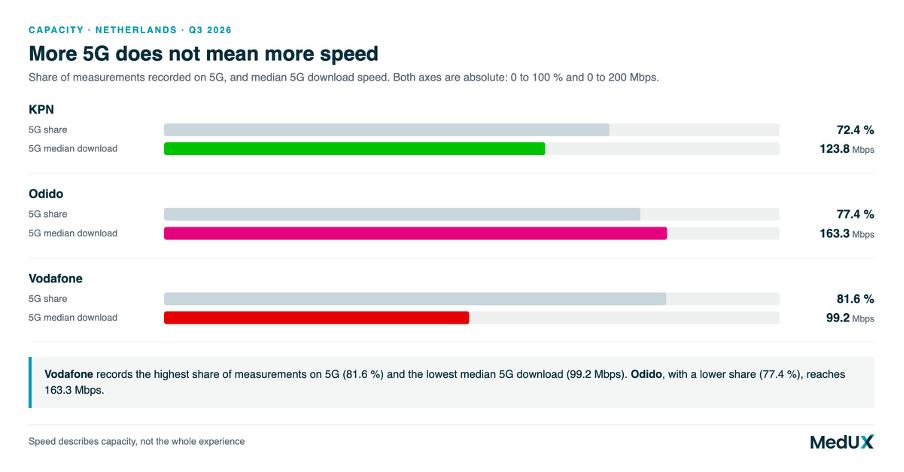
Vodafone records the highest share of measurements on 5G (81.6%), yet the lowest median 5G download speed (99.2 Mbps). Odido, with a lower observed 5G share (77.4%), achieves 163.3 Mbps at the median, approximately 64 Mbps higher. Greater observed 5G presence does not necessarily translate into faster downloads or better overall mobile experience.
The observed 5G experience is overwhelmingly non-standalone (NSA) across all three operators: less than 0.1% of the recorded 5G measurements are classified as standalone (SA) for each network. Mean observed latency ranges from 20.5 to 20.6 ms. These results describe measured consumer-device traffic during the quarter, not the full extent of each operator's 5G SA deployment.
How MedUX measured mobile experience in the Netherlands
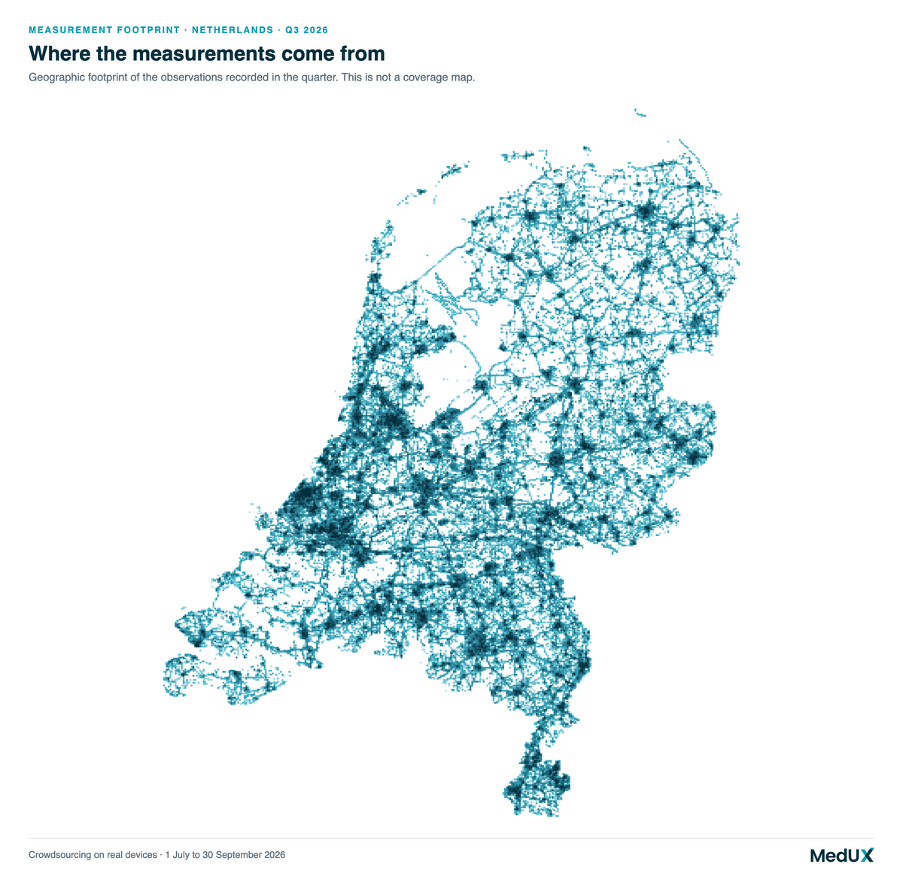
The benchmark draws on 931,105 active measurements and more than 97 million passive radio samples collected from 1 July to 30 September 2026 through MedUX crowdsourcing on real-user devices. Active measurements were taken using each operator's own SIM and mobile network. Wi-Fi and roaming sessions were excluded. Radio samples provide network context and quality control and do not enter the Experience Score. Speed figures in this article are medians restricted to 5G measurements and are standardised geographically. The averages published in the MedUX Connectivity Observatory cover all radio technologies without that standardisation, so the two are not directly comparable.
MedUX translates technical KPIs into service-specific experience scores that reflect both whether a task completes adequately and the quality delivered. This approach prevents exceptional peak performance from masking an inconsistent service experience.
Results are geographically standardised against the Eurostat Census 2021 population grid (1 km²), using a hierarchical estimator to reduce the influence of locations with disproportionate numbers of observations.
The results describe experience in the observed measurement footprint. They are not a coverage or network-availability assessment, and geographic standardisation does not make the voluntary crowdsourcing sample probabilistically representative of the population.
Measuring the experience users actually receive
Quality of Service metrics such as throughput and latency remain essential, but they do not explain the full customer experience.
Mobile users experience networks through applications and services: watching video, browsing, gaming, using social media and accessing cloud platforms. The Dutch results illustrate why a single network indicator is insufficient. The operator with the greatest observed 5G share does not have the highest median 5G download speed, while the operator with the highest numerical Streaming score does not have the greatest share of 4K playbacks.
That is why MedUX combines network-performance indicators with service-level QoE metrics and a common scoring framework, applied equivalently to every operator evaluated.
Beyond the overall score, where does each mobile network stand out?
Explore the Netherlands Q3 2026 Mobile Network Experience Snapshot for a visual overview of the experience scoring, results by service, statistical leadership and the geographic measurement footprint.
The snapshot includes:
- The national MedUX Experience Score and its statistical status.
- The full experience scoring by dimension.
- Service-level results for streaming, web browsing, social media, gaming and cloud.
- What each dimension measures.
- The measurement footprint of the period.
- Scope, method and the criterion applied for statistical leadership.
Download the Netherlands Q3 2026 Mobile Network Experience Snapshot
Methodology
For more information on MedUX's approach to mobile crowdsourcing and service-level QoE benchmarking:
Explore MedUX's Mobile QoE Crowdsourcing Benchmarking Methodology
The Netherlands Q3 2026 benchmark applies version 2026.1 of that methodology. Country-specific scope, measurement period, operator eligibility, population reference and the statistical evidence behind leadership decisions are documented in the Country Crowdsourcing Report.
Don’t forget to follow us on social media and subscribe to our newsletter to receive the latest updates and news.
Follow us on:


About MedUX
MedUX is the leading Quality of Experience (QoE) company, providing comprehensive and innovative solutions for measuring the performance of fixed, mobile, and TV telecommunications networks for telecom operators, governments, and digital enterprises.
With a focus on delivering grand scale, end-to-end network, and service visibility, MedUX leverages real-time customer perspective data and advanced analytics to ensure quality and regulatory compliance, while also offering valuable insights for optimizing networks and improving customer experiences.
With a presence in over 25 countries across Europe, America, Africa, and the Middle East, and monitoring over 60 operators worldwide, MedUX's patented technology and expertise make it a trusted partner for improving the digital experiences of customers everywhere.