
Satellite Broadband vs Fixed Broadband: LEO, GEO and Real-World QoE

Satellite broadband is no longer just a backup option.
For years, satellite connectivity was mostly associated with remote access, emergency communications, maritime operations, government services and areas beyond the reach of terrestrial infrastructure. Traditional GEO satellite broadband provided wide coverage, but its high latency limited the quality of interactive digital experiences.
That is changing with Low Earth Orbit satellite broadband.
LEO constellations operate much closer to Earth than geostationary satellites, reducing latency and making broadband services such as web browsing, video streaming, cloud applications and video calls more viable from the user perspective.
The market question has evolved.
It is no longer only: can satellite connect remote users?
It is now: can LEO satellite broadband deliver a digital experience close to fixed broadband?
That distinction matters.
Most users do not experience satellite broadband as “space connectivity”. They experience it through a router, a Wi-Fi network, a smartphone, a laptop, a video call, a streaming app or a web browser. In other words, the real competitive battlefield is not only coverage. It is Quality of Experience.

GEO vs LEO satellite broadband: why the technology shift matters
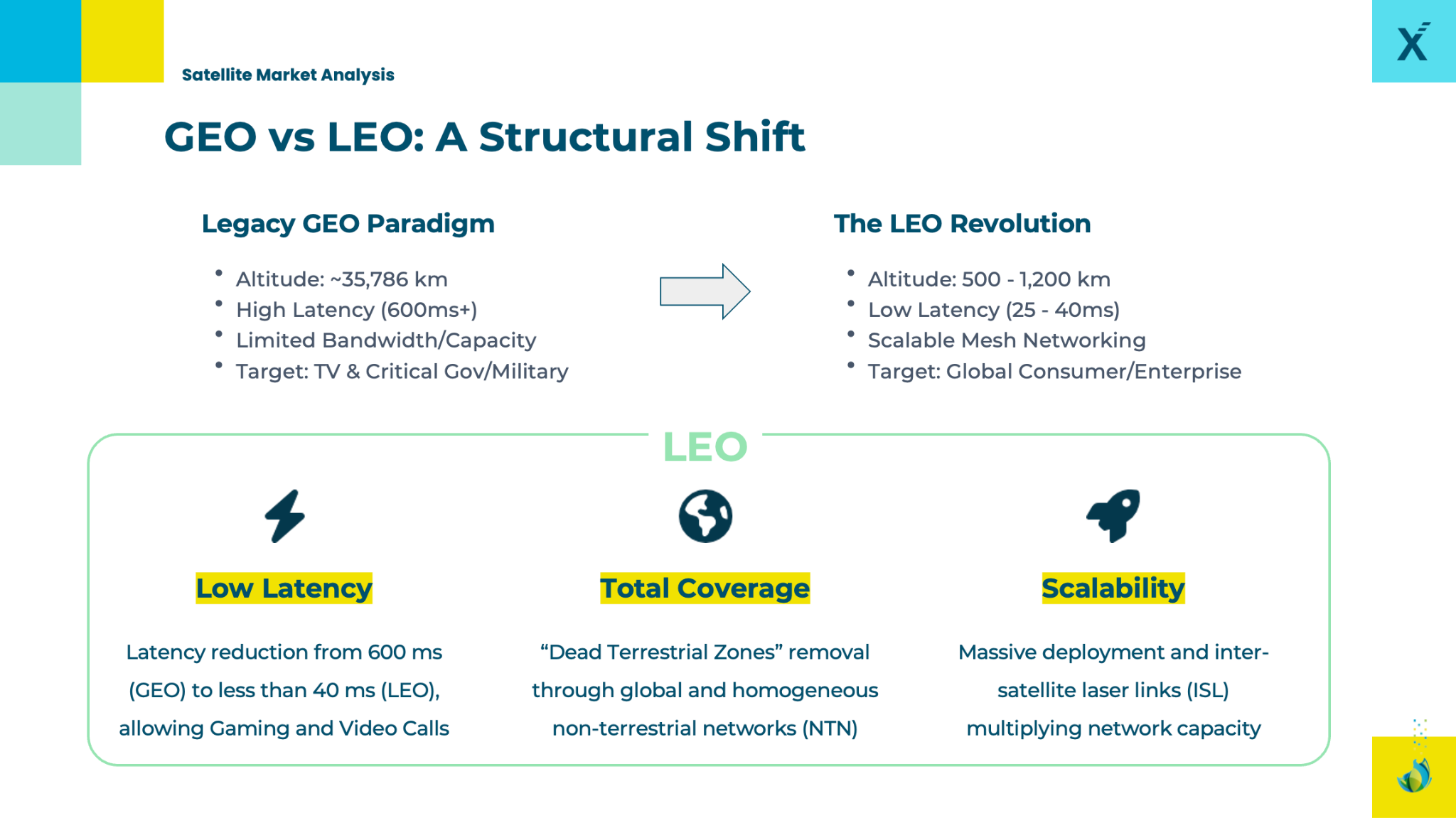
The transition from GEO to LEO is one of the most important changes in satellite broadband.
GEO satellites are positioned much farther from Earth and have historically delivered broad coverage but high latency. This made them useful for coverage and continuity, but less suitable for latency-sensitive services.
LEO satellites, by contrast, operate closer to Earth. This reduces round-trip time and improves the feasibility of more interactive broadband experiences, including video calls, streaming, web browsing and cloud-based applications.
For users, the difference between GEO and LEO is not only technical. It is experiential.
A lower-latency satellite connection can change satellite broadband from a last-resort connectivity option into a more practical broadband layer for homes, businesses and underserved areas.
What MedUX measured
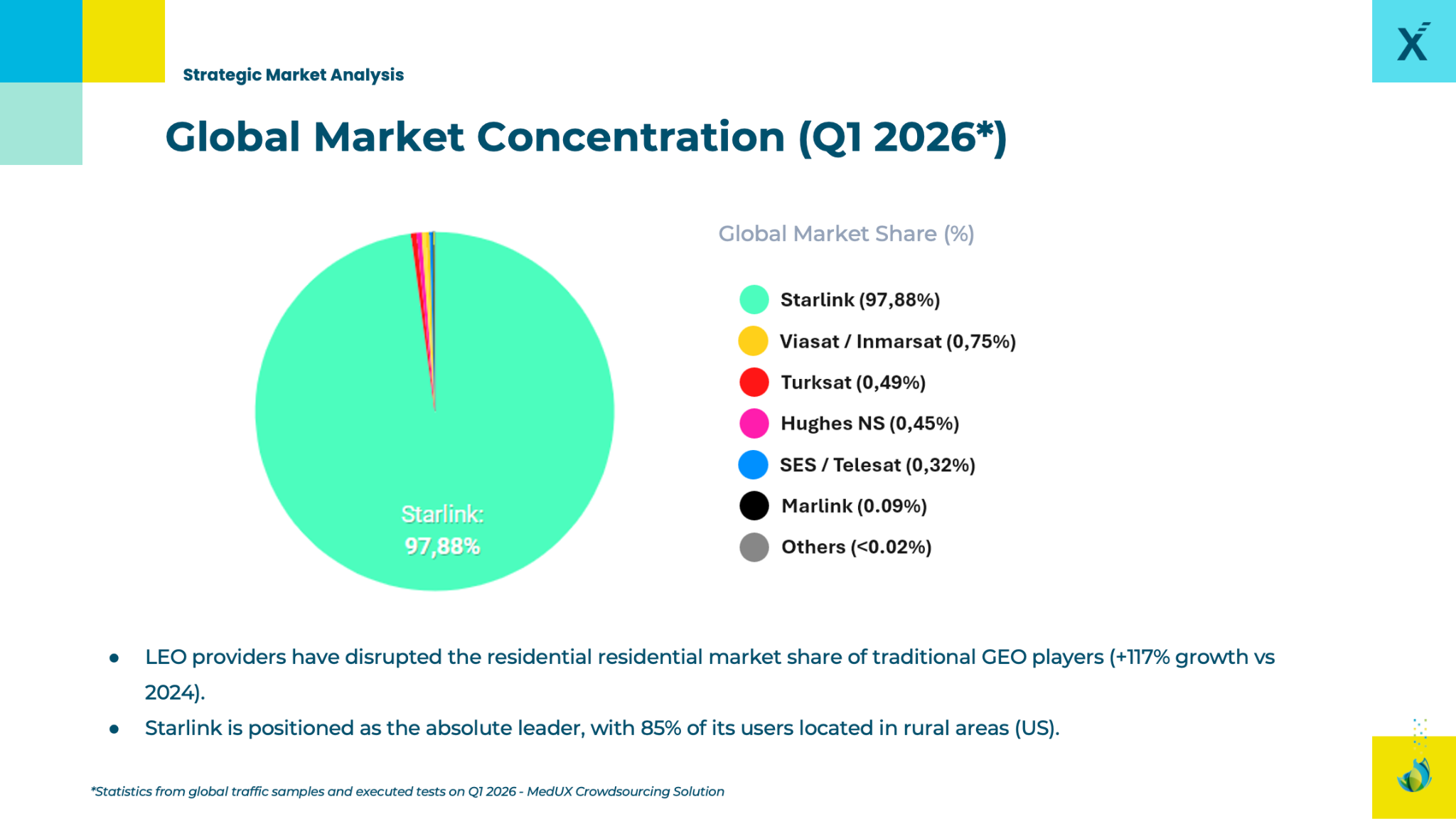
For this analysis, MedUX used Q1 2026 crowdsourcing data from smartphones connected via Wi-Fi to satellite broadband networks.
The right question for this dataset is:
How close is LEO satellite broadband to the fixed broadband experience users expect at home, at work or in underserved locations?
The satellite sample is highly concentrated around the current LEO market structure. This means the results should be interpreted primarily as a LEO-led satellite broadband benchmark, not as a fully balanced comparison across all satellite technologies or providers.
Satellite broadband is closing the fixed broadband experience gap
The most relevant finding from MedUX’s Q1 2026 analysis is that satellite broadband is already delivering a user experience that comes close to fixed broadband for everyday digital activities.
In the analyzed dataset, satellite broadband recorded:

These results show that satellite broadband can support common digital use cases such as browsing, video streaming and everyday application usage with a level of experience increasingly close to fixed broadband.
That does not mean satellite broadband has caught up with fixed broadband in every dimension.
But it does mean the experience gap is narrowing.
Fixed broadband still leads in throughput and latency
Satellite broadband is improving quickly, but fixed broadband still has structural advantages.
MedUX data shows that fixed broadband outperforms satellite in average download, upload and latency:

The biggest gap is upload performance, where fixed broadband remains clearly ahead. Latency is also lower on fixed broadband, which matters for gaming, real-time collaboration, enterprise applications and cloud-based services.
This is the right interpretation:
Satellite broadband is becoming a credible alternative where fixed broadband is unavailable, inconsistent, expensive to deploy or unable to meet user expectations.
But in well-served areas, fixed broadband continues to offer stronger fundamentals, especially for low-latency and upstream-intensive use cases.
The conclusion is not that satellite replaces fixed broadband.
The conclusion is that LEO satellite is becoming a serious broadband layer where traditional fixed infrastructure struggles to scale.
What about mobile broadband?
Mobile broadband remains relevant, but it should be treated carefully.
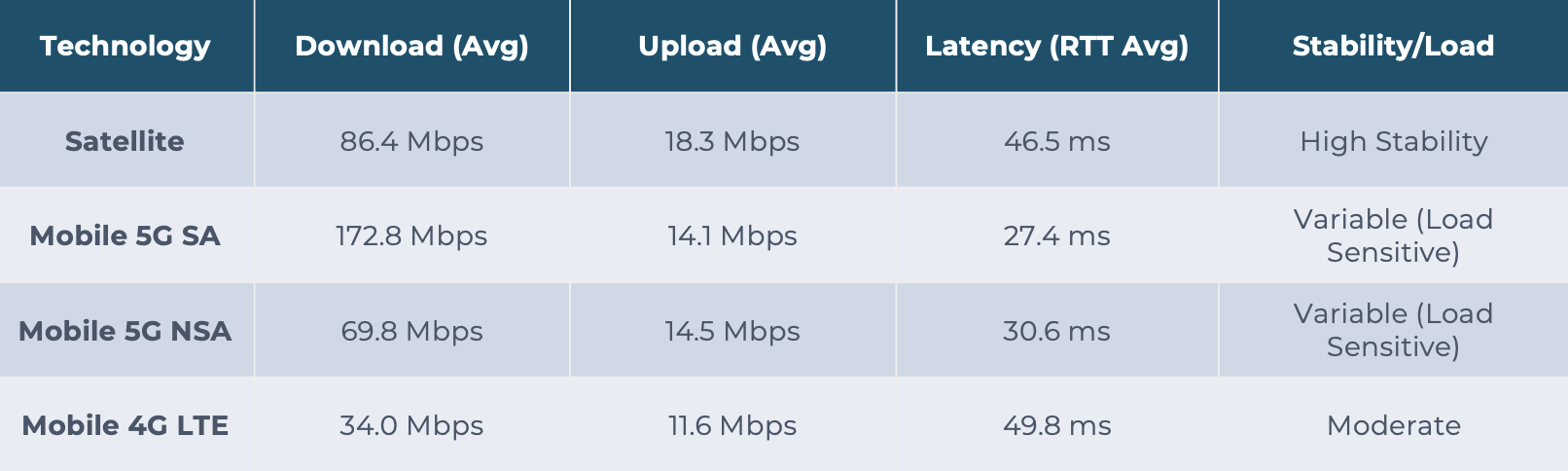
A smartphone connected via Wi-Fi to a satellite broadband router is not the same as a smartphone connected directly to a 4G or 5G mobile network. The access architecture, radio conditions, mobility model and service expectations are different.
For that reason, mobile should not be the main benchmark in this analysis.
However, mobile broadband can still provide useful context in specific scenarios. Satellite broadband may be relevant where mobile coverage is poor, congested or unavailable. It can also act as a resilience layer for enterprises, emergency services, rural users or remote operations.
The message should be clear:
Satellite broadband is not replacing mobile broadband. It is becoming a complementary connectivity layer.
Direct-to-Device and NTN: the next benchmark frontier
The comparison between satellite and mobile will become more direct as satellite-to-mobile services mature.
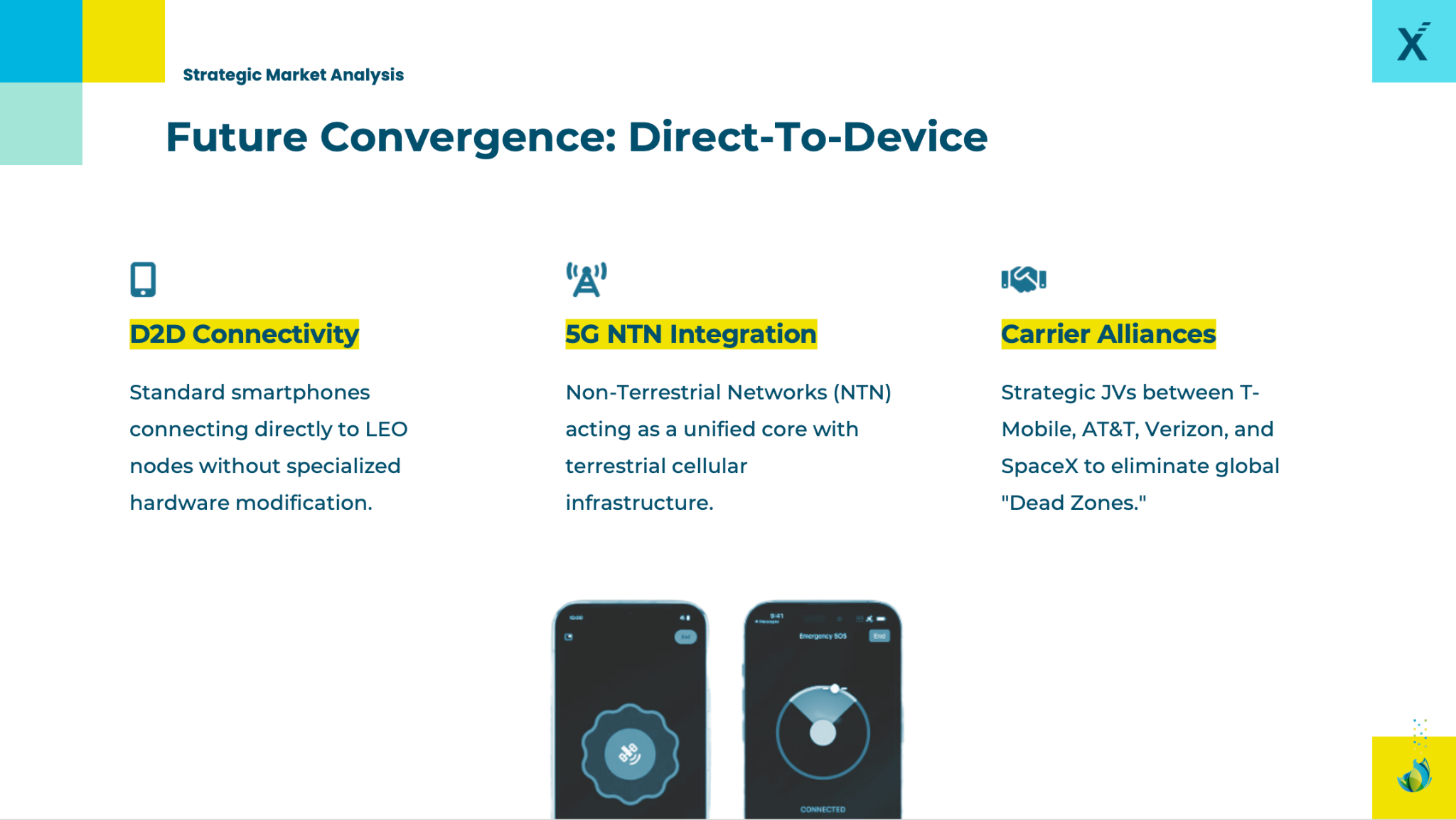
Direct-to-Device connectivity aims to allow standard smartphones to connect directly to LEO satellite nodes without specialized hardware modifications. At the same time, 5G NTN integration is opening the door to non-terrestrial networks becoming part of a more unified architecture with terrestrial mobile infrastructure.
This will create a new measurement challenge.
When users move across fiber, Wi-Fi, FWA, 4G, 5G and satellite layers, quality can no longer be assessed only through isolated network KPIs or technology labels.
Operators, regulators and enterprises will need a technology-agnostic way to understand how connectivity performs from the user perspective.
That is the space where QoE becomes the common language.
Why QoE matters for satellite broadband
Coverage maps are not enough. Speed tests alone are not enough. Technology labels are not enough.
A meaningful broadband benchmark must answer practical questions:
- Can users browse smoothly?
- Can video start quickly and maintain high resolution?
- Can cloud applications remain stable?
- Can real-time services perform reliably?
- Does performance degrade during peak hours?
- How much of the experience is affected by access technology, Wi-Fi, congestion, routing or service platform behavior?
This is where MedUX provides a unique perspective.
MedUX measures network and service performance from the customer perspective, combining active testing devices, crowdsourcing, Apps & SDK, advanced analytics and QoE scorecards to help operators, regulators and enterprises understand how networks actually perform in the real world. MedUX’s own resources describe this focus around QoE and internet performance testing and monitoring.
As satellite becomes part of the broadband competitive landscape, this multi-platform perspective becomes even more important.
Because the future will not be defined by one winning access technology.
It will be defined by how fiber, FWA, mobile, Wi-Fi and satellite work together to deliver reliable, inclusive and high-quality digital experiences.
Frequently Asked Questions about Satellite Broadband, LEO, GEO and QoE
What is the difference between GEO and LEO satellite broadband?
GEO satellite broadband uses satellites positioned much farther from Earth, which enables wide coverage but typically introduces higher latency. LEO satellite broadband uses satellites closer to Earth, reducing latency and making interactive broadband services such as video calls, streaming and cloud applications more viable.
Is satellite broadband better than fixed broadband?
Not generally. MedUX Q1 2026 data shows that satellite broadband is approaching fixed broadband for everyday web and video experience, but fixed broadband still leads in download speed, upload speed and latency. Satellite is strongest where fixed broadband is unavailable, inconsistent or costly to deploy.
Does this analysis measure Direct-to-Device satellite connectivity?
No. This analysis is based on smartphones connected via Wi-Fi to networks identified as satellite internet providers. Direct-to-Device satellite connectivity is a different use case and will require a dedicated mobile-satellite benchmark as the technology matures.
Why is QoE important for satellite broadband?
QoE shows whether the connection supports real user needs such as browsing, streaming, video calls, cloud applications and real-time services. Speed alone does not explain the full user experience, especially when Wi-Fi, latency, routing, congestion and service behavior also affect performance.
Want to know more?
Don’t forget to follow us on social media and subscribe to our newsletter to receive the latest updates and news.
Follow us on:


About MedUX
MedUX is a global leader in Quality of Experience testing and monitoring, helping telecom operators, regulators, governments and digital enterprises understand how users actually experience fixed, mobile and Wi-Fi networks.
Through a multi-platform measurement ecosystem — including mobile and fixed probes, apps, SDKs, crowdsourcing and advanced analytics — MedUX provides end-to-end visibility into network and service performance, supporting benchmarking, optimization, regulatory compliance and customer experience improvement across markets worldwide.