
Movistar leads MedUX’s Q3 2026 Mobile Network Experience Benchmark in Spain

How good is a mobile network when you look beyond speed?
MedUX’s latest Mobile Network Experience Benchmark in Spain combines controlled field measurements with nationwide crowdsourcing to assess how networks perform across the services and conditions that shape real Quality of Experience (QoE).
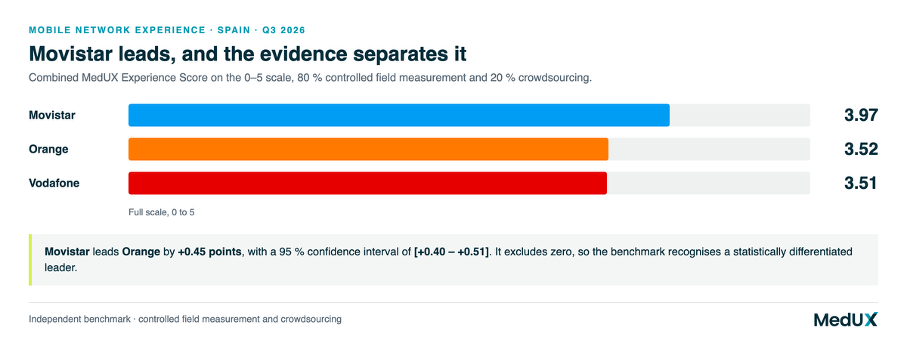
The Q3 2026 benchmark evaluates Movistar, Orange and Vodafone and identifies Movistar as the statistically differentiated leader among the three operators evaluated, with a combined MedUX Experience Score of 3.97 out of 5.
Orange scores 3.52 and Vodafone 3.51. The difference between Orange and Vodafone is not statistically conclusive, so the benchmark does not establish a second- and third-place ranking between them.
One leader overall, but the story goes deeper than the headline
Movistar leads not only the overall Experience Score, but also the other five main dimensions recognised in the combined benchmark: Reliability, Data & OTT, Streaming, Value for Speed and Accessibility.
However, the size of the gap varies significantly depending on the experience being measured.
Accessibility shows the widest gap in the benchmark. Movistar scores 3.47 out of 5, compared with 2.40 for Vodafone and 2.36 for Orange, resulting in the largest statistically differentiated advantage across the main experience dimensions. This reinforces why mobile experience cannot be reduced to throughput alone: responsiveness and the ability to access services consistently also shape what users actually experience.
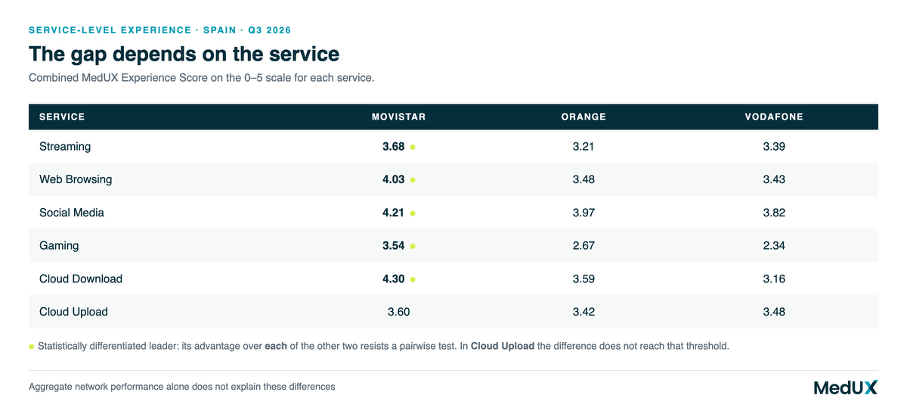
At service level, Gaming and Cloud Download show some of the largest differences between operators, while Cloud Upload is much more closely grouped. This illustrates why mobile experience cannot be understood through aggregate throughput alone. Similar technical performance does not necessarily translate into the same experience when users browse, stream, play online or use cloud applications.
The competitive picture below the overall leader also varies by dimension. Orange records the second-highest point estimate in Value for Speed and Data & OTT, while Vodafone records the second-highest point estimate in Reliability, Streaming and Accessibility. These are descriptive score differences rather than separate second-place statistical awards.
The benchmark also looks at complementary indicators including 4G and 5G performance, latency and jitter, voice quality, and even the response time observed when interacting with an AI assistant.
Download the full Spain Mobile Network Experience Q3 2026 Report
5G widens the capacity gap, but speed is not the same as experience
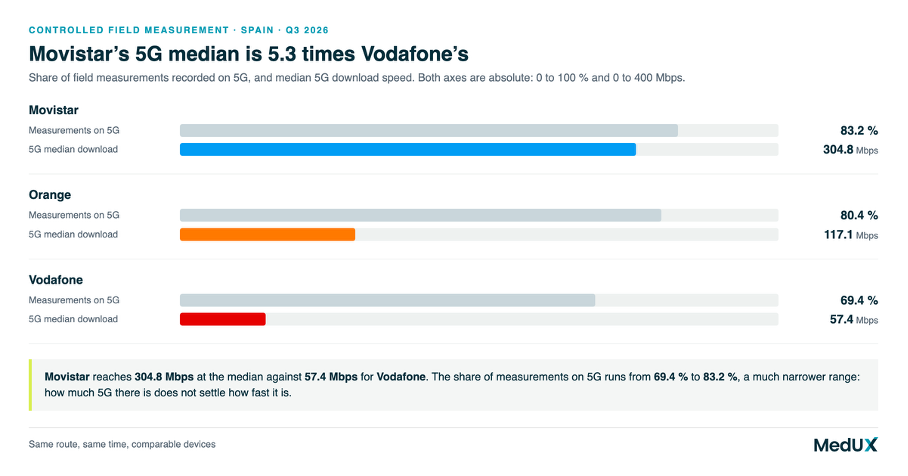
The data show particularly visible differences in 5G performance.
In the controlled field campaign, Movistar records the strongest 5G download performance across low, typical and high-end conditions. The crowdsourcing data also show substantial differences in 5G performance between the operators evaluated.
But the benchmark is not a speed race.
The ordering observed in throughput does not reproduce uniformly across digital services. MedUX therefore evaluates dimensions such as reliability, accessibility, streaming and Data & OTT, translating technical KPIs into experience-oriented scores.
That distinction matters. A network can deliver high peak throughput and still perform differently when the user is gaming, loading a website, watching video or interacting with a cloud service.
Emerging services: measuring the experience of AI assistants
The benchmark also looks at an increasingly relevant digital use case: AI assistants. In the controlled field measurements, MedUX measured the end-to-end response time of an AI assistant, capturing a service that depends more on latency and transport behaviour than on raw bandwidth.
Median response time ranged from 1.36 to 1.49 seconds across the operators evaluated, with Movistar recording the lowest median at 1.356 seconds, followed by Orange at 1.453 seconds and Vodafone at 1.489 seconds. The difference becomes wider at the slower end of the distribution.
Assessing mobile experience through speed alone is insufficient, as emerging interactive services introduce new performance requirements that conventional throughput benchmarks often miss.
Download the full Spain Mobile Network Experience Q3 2026 Report
How MedUX measured mobile experience in Spain
What makes this benchmark different is the combination of two complementary measurement sources.
Controlled field measurement
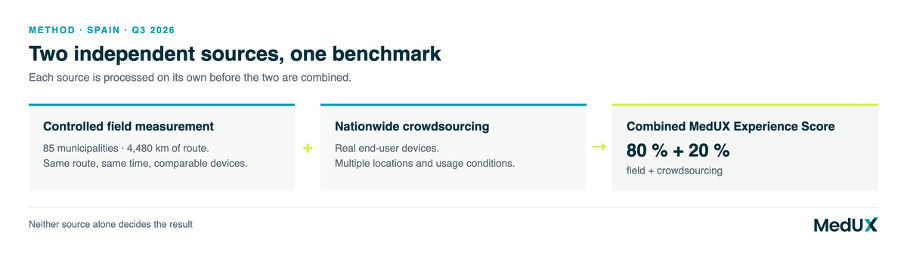
Between 20 July and 26 September 2026, MedUX carried out a controlled field campaign covering 4,480 km across 85 municipalities.
The three operators were measured in parallel using equivalent devices, on the same routes and at the same time. This approach is designed to maximise comparability between networks under controlled conditions.
Nationwide crowdsourcing
The second source comes from measurements collected on real end-user devices throughout the quarter.
Crowdsourcing extends the analysis to a broader diversity of devices, locations, times and usage conditions that cannot be fully reproduced in a controlled field campaign.
Each source is processed independently before being combined into the official benchmark result:
80% controlled field measurement + 20% crowdsourcing.
The field campaign provides a consistent operator-to-operator comparison, while crowdsourcing adds evidence from distributed, real-device conditions.
The statistical evidence behind each verdict
MedUX does not treat every numerical difference as meaningful.
A unique leader is recognised only when the advantage over every relevant competitor is statistically significant at the 95% confidence level.
For the overall benchmark, Movistar’s +0.45-point advantage over the next operator has a 95% confidence interval of [0.40–0.51], supporting a statistically differentiated leadership result.
By contrast, the difference between Orange and Vodafone does not support a statistically conclusive ordering.
This statistical layer is important because mobile benchmarking involves variability across measurements, locations and users. A robust benchmark should distinguish between an observed numerical difference and one that the available evidence actually supports.
Measuring the experience users actually receive
Quality of Service metrics such as throughput and latency remain essential, but they do not explain the full customer experience.
Mobile users experience networks through applications and services, watching video, browsing, gaming, using social media, accessing cloud platforms, making calls or increasingly interacting with AI-based services.
That is why MedUX combines network-performance indicators with service-level QoE metrics and a common scoring framework.
The result is a view of mobile performance that connects technical behaviour with the experience delivered across real digital services, one of the core principles of MedUX’s broader mobile QoE methodology.
Explore the full Spain Q3 2026 Mobile Network Experience Report
The full report includes:
- the combined national benchmark and statistical verdicts;
- the full Experience Scorecard;
- service-level results;
- controlled 4G and 5G measurements;
- gaming latency and jitter analysis;
- AI assistant response-time measurements;
- voice quality based on real calls and POLQA;
- the crowdsourcing view;
- methodology, weighting and statistical confidence details.
Download the full Spain Mobile Network Experience Q3 2026 Report
Explore more mobile QoE benchmarks in the MedUX Connectivity Observatory
The Observatory is MedUX’s dedicated environment for mobile QoE and operator benchmark reports across markets. observatory.medux.com
Methodology
For more information on MedUX’s general approach to mobile crowdsourcing and service-level QoE benchmarking:
Explore MedUX's Mobile Crowdsourcing Benchmarking Methodology
The Spain Q3 2026 benchmark uses a specific multi-source configuration combining controlled field measurement and crowdsourcing. The full report contains the methodology applied to this edition.
Don’t forget to follow us on social media and subscribe to our newsletter to receive the latest updates and news.
Follow us on:


About MedUX
MedUX is the leading Quality of Experience (QoE) company, providing comprehensive and innovative solutions for measuring the performance of fixed, mobile, and TV telecommunications networks for telecom operators, governments, and digital enterprises. With a focus on delivering grand scale, end-to-end network, and service visibility, MedUX leverages real-time customer perspective data and advanced analytics to ensure quality and regulatory compliance, while also offering valuable insights for optimizing networks and improving customer experiences. With a presence in over 25 countries across Europe, America, Africa, and the Middle East, and monitoring over 60 operators worldwide, MedUX’s patented technology and expertise make it a trusted partner for improving the digital experiences of customers everywhere.