
Satellite Direct-to-Device During Spain's Wildfires: What Device-Level Data Reveals
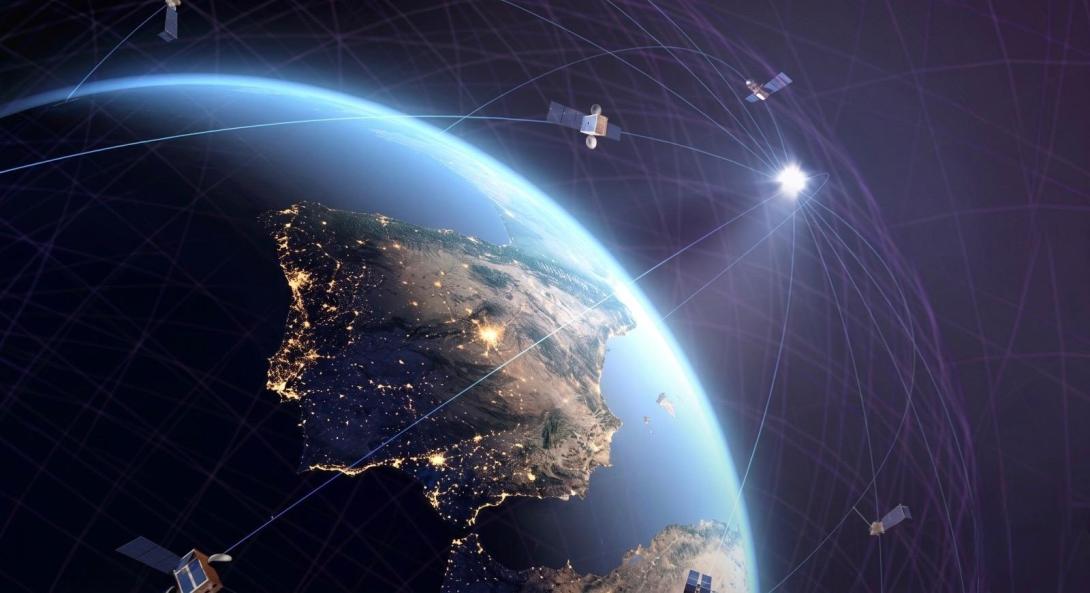
During an emergency, connectivity becomes part of the critical infrastructure supporting alerts, operational coordination and access to essential information.
Our thoughts remain with the communities affected by the wildfires in central Spain. We also recognise the work of the emergency services, public authorities, mobile operators and technical teams involved in protecting people and restoring essential services.
Between 23 July and 3 August 2026, MedUX analysed more than 28.5 million signal scans collected from consumer devices in the affected regions leveraging its crowdsourcing data.
Within this dataset, MedUX identified more than 4,000 validated observations of a satellite direct-to-device layer across the affected provinces, with sustained activity concentrated in a small number of municipalities. The data showed subscriptions associated with Movistar and MasOrange accessing the same Starlink Direct to Cell service during periods of severe terrestrial network disruption.
Alongside the passive radio network data, MedUX captured active speed, latency and web browsing measurements. These results provide an initial view of both the connectivity and the digital experience that this type of emergency satellite service can deliver today.
Direct-to-device connectivity in a real emergency
Satellite connectivity is becoming increasingly integrated with the mobile ecosystem through non-terrestrial networks, commonly known as NTN.
NTN is a broad category covering network architectures that use airborne or space-based platforms to complement terrestrial infrastructure. These architectures can include satellites operating in different orbits, as well as other types of non-terrestrial platforms.
Starlink operates a constellation in low Earth orbit, or LEO. Because LEO satellites orbit closer to the Earth than traditional geostationary satellites, they can reduce propagation distance and support more responsive connectivity.
Orbit, however, is only one factor influencing performance. Radio conditions, spectrum availability, routing, network architecture and service configuration also shape the experience delivered to the user.
Satellite direct-to-device, usually abbreviated as D2D, is one of the most relevant NTN use cases. It allows compatible consumer devices to communicate directly with satellites using mobile spectrum.
Starlink calls its implementation Direct to Cell.
Unlike conventional satellite communications, Direct to Cell does not require a dedicated satellite handset or external antenna. When the required technical, regulatory and commercial arrangements are in place, compatible smartphones can access the satellite layer when terrestrial service is unavailable.
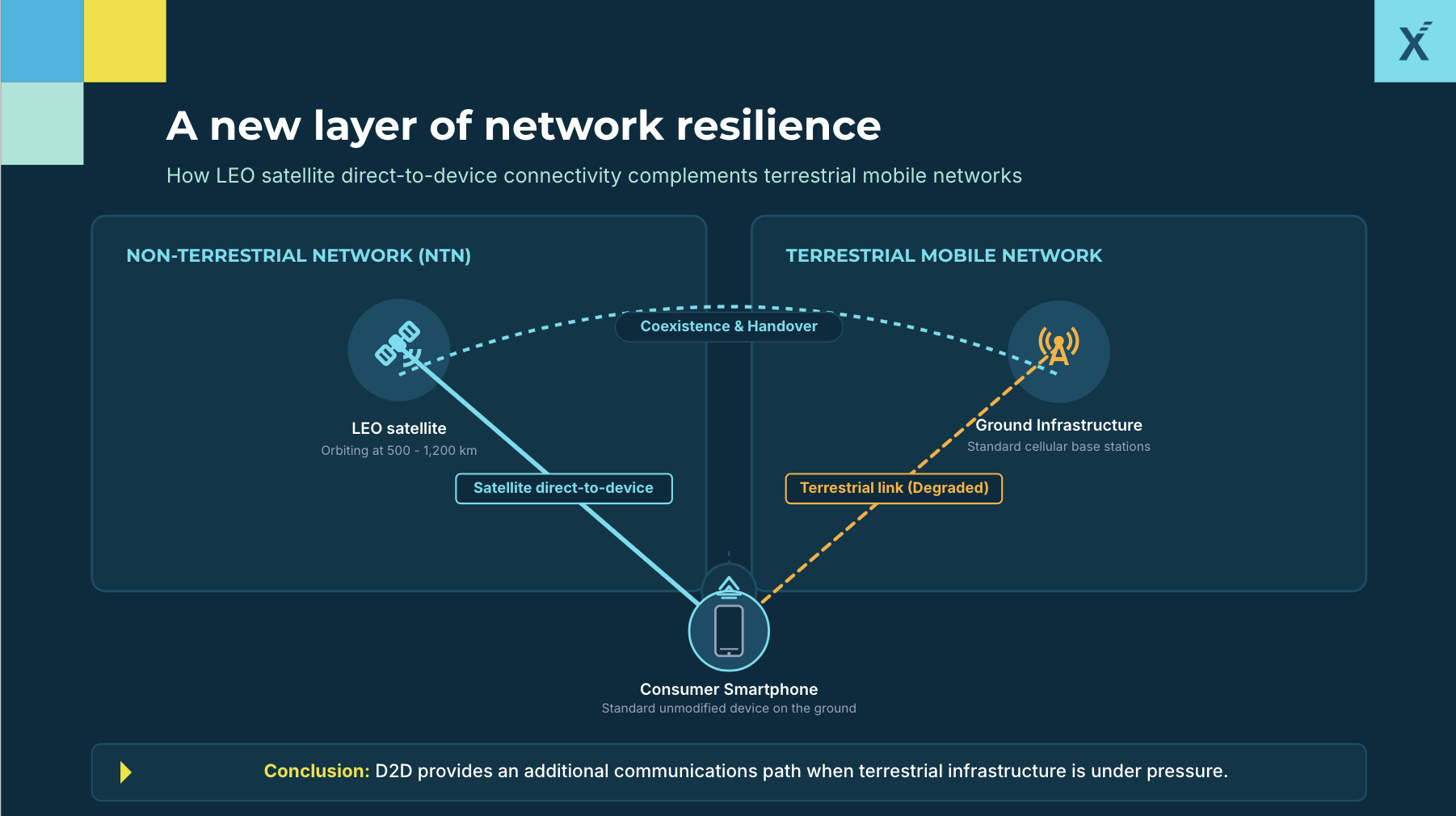
During the wildfires, Movistar and MasOrange worked with SpaceX to provide basic emergency connectivity through Starlink Direct to Cell.
MedUX independently observed the resulting service from consumer devices. The analysis did not require access to the internal systems of Movistar, MasOrange or SpaceX, nor did it depend on equipment deployed specifically for the event.
The findings show Direct to Cell operating as an additional layer of resilience. It supported essential connectivity when terrestrial mobile networks were under severe pressure, without replacing their usual capacity or performance.
How MedUX identified the satellite layer
Identifying a satellite connection from device data requires more than looking at a network identifier.
Smartphones that have lost service may scan all networks visible in their surroundings. These scans can produce records associated with networks to which the device has not established an active connection.
MedUX therefore applied a multi-parameter validation method.
The analysis combined the mobile network identity, radio technology, frequency band, channel configuration and subscriber group reported by the terminal.
The validated satellite activity was predominantly observed in LTE band 7 at 2600 MHz, using a 5 MHz channel. The same radio configuration appeared across the regions covered by the analysis.
Combining these parameters allowed MedUX to distinguish validated Direct to Cell activity from ordinary network scanning and follow the behaviour of the satellite layer across geography and time.
This illustrates the value of measuring connectivity from the device perspective. A new network layer can be independently detected and technically characterised without direct integration with the infrastructure involved.
A shared satellite layer for two operator groups
The device data confirmed that subscriptions associated with two operator groups, Movistar and MasOrange, registered on the same satellite connectivity layer.
This behaviour differed from the normal terrestrial registration patterns observed in the same regions.
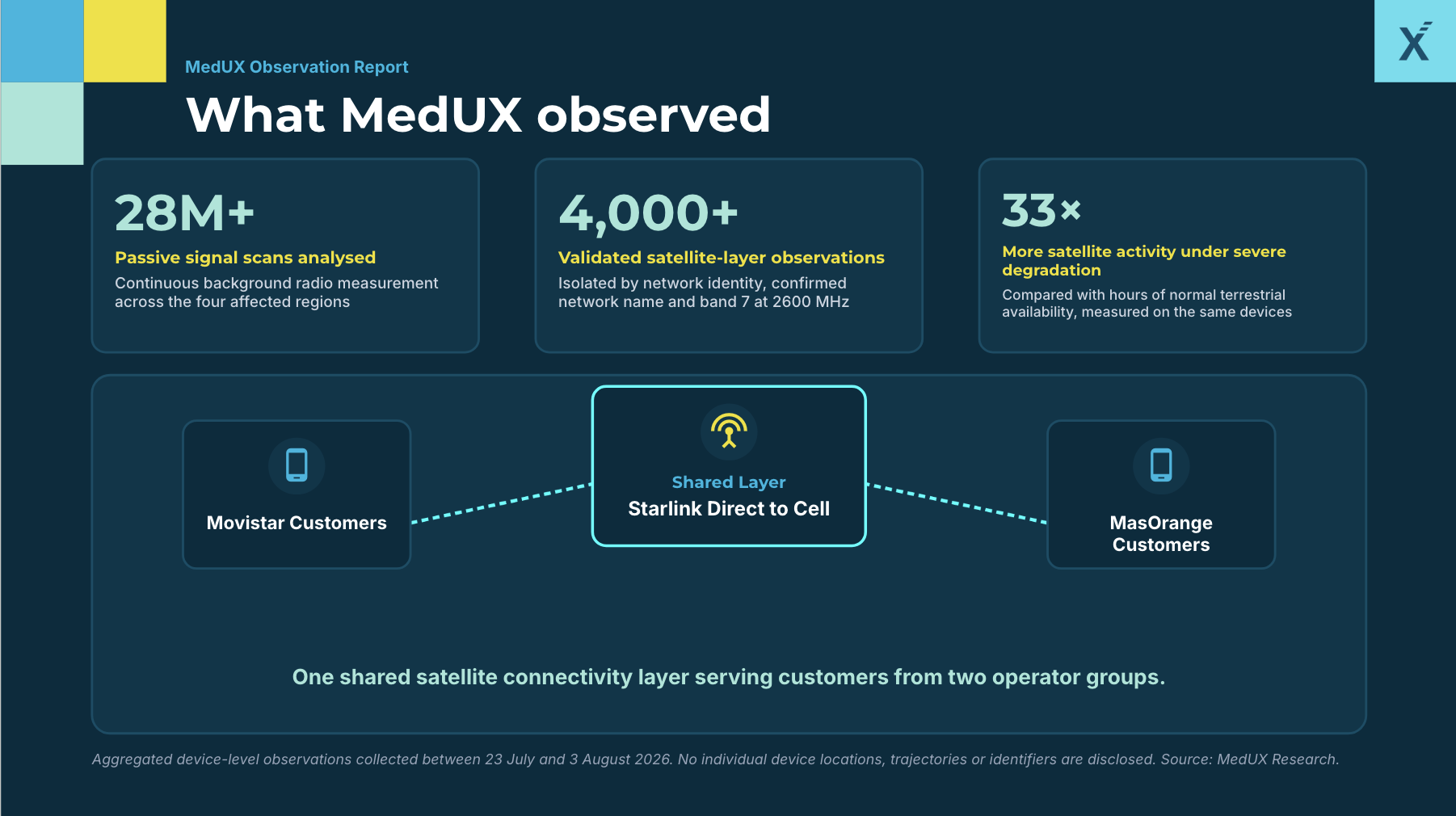
Under ordinary conditions, subscriptions remained overwhelmingly connected to the terrestrial infrastructure of their own operator. During the emergency, eligible customers from Movistar and MasOrange could access a shared Starlink Direct to Cell layer when device compatibility, service configuration and local radio conditions allowed it.
The cooperation therefore occurred through the satellite service rather than through a general opening of the operators' terrestrial networks.
This distinction is relevant for network resilience.
An emergency connectivity layer becomes more valuable when it can support customers from more than one operator instead of acting as an isolated extension of a single mobile network.
The case also shows that resilience depends on more than satellite technology. Spectrum availability, roaming arrangements, subscriber configuration, device compatibility and operational coordination all influence whether the service reaches the people who need it.
When did Direct to Cell become most relevant?
MedUX compared the activity of the satellite layer with terrestrial network availability across the affected area.
The analysis found a clear change during the most severe disruption periods.
When terrestrial availability remained normal or experienced only moderate degradation, Direct to Cell activity was comparatively low. Satellite activity increased sharply when terrestrial availability moved into the most severely degraded ranges.
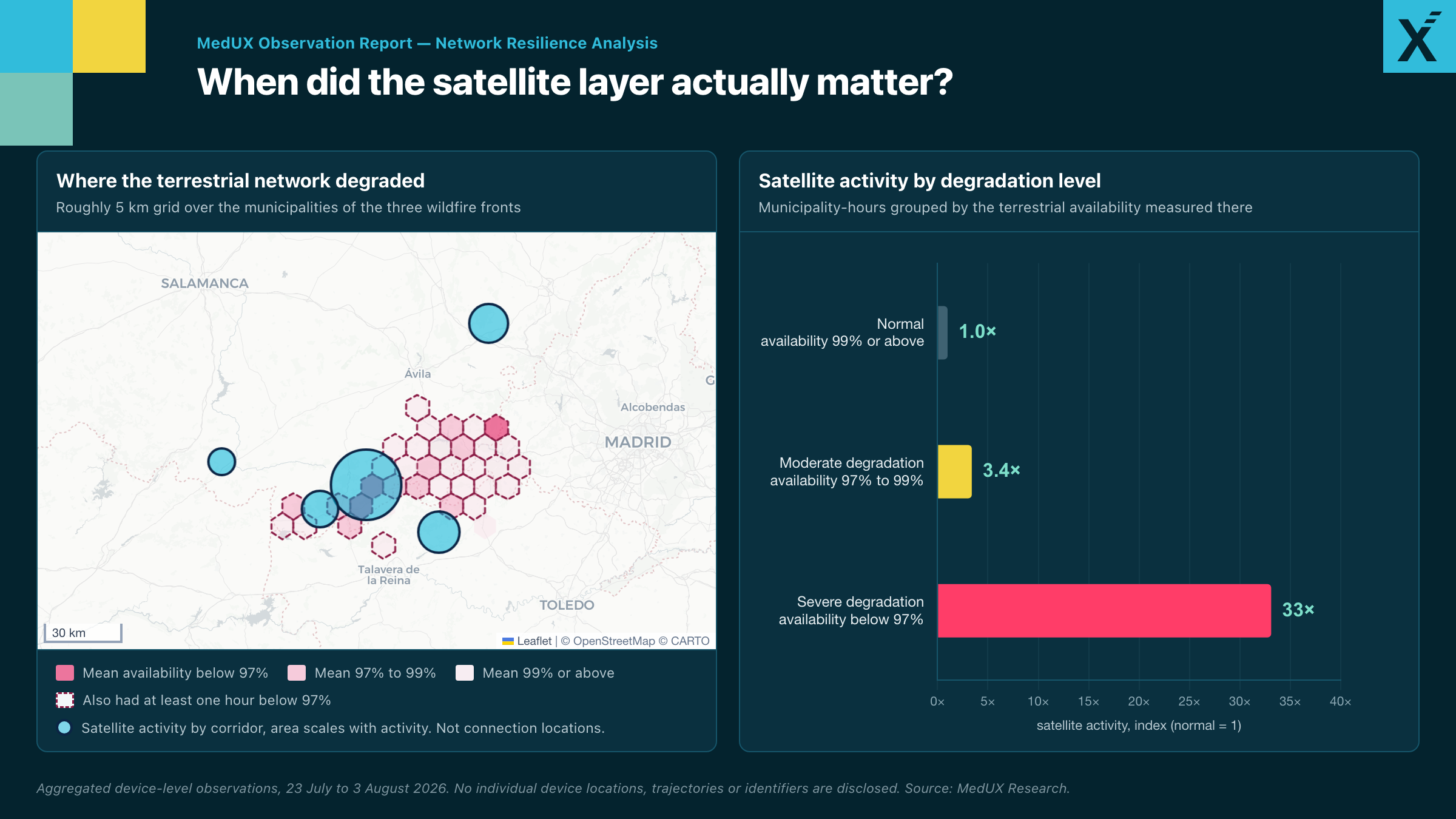
Terrestrial network degradation in the wildfire area, and how much more the satellite layer was used as availability fell. Satellite activity is aggregated by corridor; the circles are not connection locations.
This pattern does not mean that every terrestrial disruption produced the same level of satellite activity.
Some areas with longer periods of degradation recorded less Direct to Cell activity than locations where the terrestrial impact was shorter. Usage can also be influenced by satellite visibility, beam footprint, device compatibility, subscriber configuration, the number of people present and awareness that the service is available.
Despite these variables, the overall pattern was consistent. The satellite layer became significantly more active when terrestrial connectivity was under the greatest pressure.
This is the expected role of an emergency resilience layer. It remains secondary while terrestrial infrastructure is available and becomes more relevant as conventional connectivity deteriorates.
What level of network performance did MedUX observe?
The active measurements captured while devices were connected to the satellite layer included speed tests, latency tests and web browsing tests.
Observed download performance was around 1 Mbps. Round-trip latency was measured in the hundreds of milliseconds.
These results are considerably below the performance normally expected from a fully operating 4G or 5G terrestrial network. They are also consistent with a basic emergency service using limited spectrum and a satellite connection.
The measurements help establish realistic expectations.
Starlink Direct to Cell can restore a useful level of connectivity, but it does not currently reproduce the capacity or responsiveness of conventional mobile broadband.
The fact that the satellites operate in LEO does not automatically produce low end-to-end latency. Although a lower orbit reduces the physical distance travelled by the signal compared with a geostationary system, the final response time also depends on the radio link, spectrum, routing, core network and service architecture.
The active tests represent the conditions captured during this specific event. They illustrate the type of service observed rather than establishing a universal performance figure for every device, location or future deployment.
What did that performance mean for Quality of Experience?
Network performance metrics explain only part of the experience. The practical value of a connection depends on what users can do with it.
MedUX analysed web browsing tests performed through the satellite layer to understand how the measured speed and latency affected real digital services.
The majority of standard web browsing tests were unsuccessful, failing to load pages in their entirety. However, completed sessions recorded took between 10 and 13 seconds.
This difference provides a practical picture of the current Direct to Cell experience.
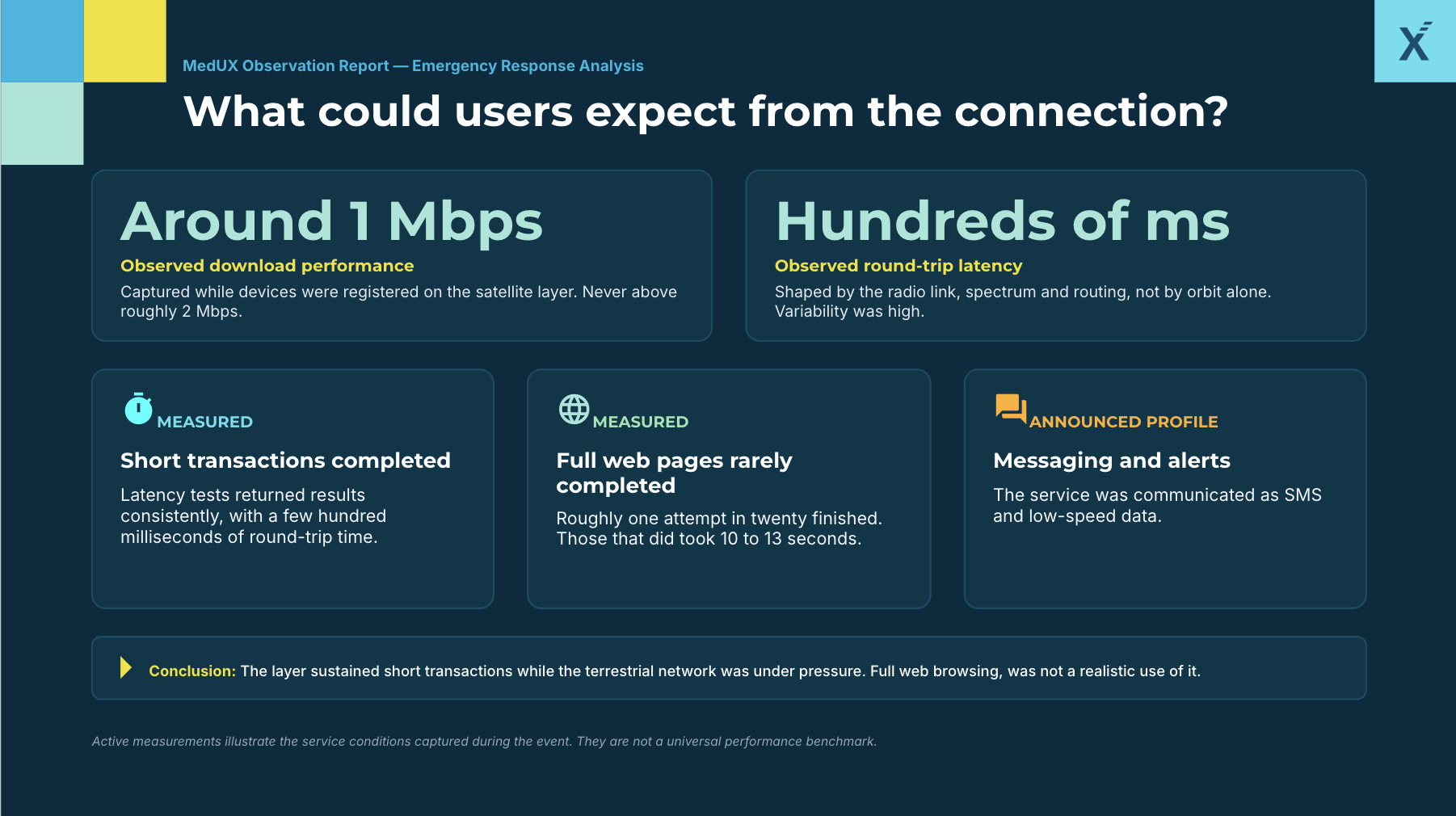
The observed service was suitable for text messaging, emergency alerts, simple information pages and lightweight web browsing. Services requiring large amounts of data or rapid interaction remained more challenging.
A user could therefore send an essential message or consult a simple emergency information page while experiencing significant delays when opening a multimedia-heavy website.
This is an important distinction. Connectivity was available, but the experience varied considerably according to the application and digital service being used.
In an emergency, even a limited connection can be extremely valuable. The ability to exchange basic information may matter more than achieving normal mobile broadband performance.
Why device-level visibility matters
Mobile operators monitor their infrastructure through network alarms, site information, performance counters and traffic data.
Device-level measurement provides a complementary perspective.
It shows whether connectivity reached the terminal, which network layer the device registered on, whether roaming was involved, which radio configuration was available and what experience digital services delivered.
This becomes especially important when terrestrial and non-terrestrial networks operate together.
MedUX was able to identify the satellite layer, validate its technical characteristics, observe subscriptions from Movistar and MasOrange using it and relate its activity to terrestrial network conditions.
The combination of passive and active measurements also connected network availability with the service experience delivered to the device.
Network data explains the condition of the infrastructure. Device-level evidence shows how that infrastructure, together with any backup layer, translated into connectivity and experience for users.
What this case means for network resilience
The case observed in Spain shows that satellite direct-to-device connectivity has moved beyond controlled demonstrations. It can provide measurable service to conventional smartphones during a real emergency.
It also demonstrates the value of interoperability.
A satellite layer capable of supporting customers from two operator groups can provide broader utility than a solution restricted to the customers of one network. Achieving this requires technical coordination and an appropriate regulatory and commercial framework.
For operators, D2D provides another option when physical infrastructure is damaged, inaccessible or temporarily unavailable.
For regulators and public authorities, the case highlights the importance of preparing activation procedures, spectrum arrangements and emergency roaming frameworks before a crisis occurs.
For the wider telecommunications industry, it reinforces the need to evaluate resilience from the user's perspective.
Confirming that a satellite service has been activated does not explain where it appeared, which customers could access it or what digital experience it delivered.
Those questions require evidence from the field.
From network backup to resilience assurance
Direct to Cell does not need to match the full performance of a terrestrial mobile network to create meaningful value.
Its purpose is different.
It provides another communications path when the primary infrastructure is unavailable or operating under severe pressure. During those moments, even limited connectivity can support alerts, messages and access to essential information.
The wildfires in central Spain offer an early view of a more converged resilience model.
Terrestrial mobile networks remained the main source of connectivity, while Starlink Direct to Cell provided an additional option for eligible Movistar and MasOrange customers during some of the most critical periods.
The next step for the industry is to make these mechanisms predictable, interoperable and measurable before the next emergency occurs.
Frequently asked questions
What is a non-terrestrial network?
A non-terrestrial network, or NTN, is a network architecture that uses airborne or space-based platforms to complement terrestrial communications infrastructure. Satellites operating in low, medium or geostationary Earth orbit can form part of an NTN architecture.
How are NTN, LEO and direct-to-device related?
NTN is the broader network category. LEO describes satellites operating in low Earth orbit. Direct-to-device is a use case in which compatible consumer devices communicate directly with a satellite.
Starlink Direct to Cell is a LEO-based implementation of satellite direct-to-device connectivity.
What is satellite direct-to-device connectivity?
Satellite direct-to-device, or D2D, allows compatible mobile devices to communicate directly with satellites using mobile spectrum, without requiring a dedicated satellite handset or external antenna.
Did Starlink Direct to Cell operate during the wildfires in Spain?
Yes. MedUX independently identified and validated satellite activity consistent with the Starlink Direct to Cell emergency service publicly made available to eligible Movistar and MasOrange customers.
Which mobile customers were observed using the service?
The MedUX data showed subscriptions associated with Movistar and the MasOrange group registering on the shared satellite layer.
What speeds did MedUX observe?
The active measurements recorded download performance in the range of a few Mbps. These results represent the conditions observed during the event rather than a universal speed for every user or location.
What latency did the connection provide?
Observed round-trip latency was in the hundreds of milliseconds. This is higher than on a normally operating terrestrial mobile network and affects services that depend on rapid interaction.
What could users realistically do with the connection?
The measured service could support messaging, alerts, simple information services and lightweight browsing. Content-heavy websites took considerably longer to load and were less suitable for an emergency connection.
Did Direct to Cell replace the terrestrial mobile networks?
No. It operated as a complementary resilience layer during periods of severe terrestrial network disruption.
Measurement approach
MedUX analysed passive signal scans collected from consumer Android devices between 23 July and 3 August 2026.
Satellite observations were validated by combining the network identity, radio technology, frequency band, channel configuration, subscriber group and roaming status reported by the device.
The analysis also included selected speed, latency and web browsing tests captured while devices were connected to the satellite layer.
The findings are presented in aggregate under MedUX privacy and geographic publication criteria. Individual device locations, trajectories and identifiers are not disclosed.
Independence
This analysis was conducted independently by MedUX. It was not commissioned, sponsored or reviewed by Movistar, MasOrange, SpaceX or any other organisation referenced in this article.
Movistar, Orange, Yoigo, MasOrange, Starlink and SpaceX are trademarks of their respective owners and are mentioned solely for descriptive purposes.
For more information don’t hesitate to contact us!
Don’t forget to follow us on social media and subscribe to our newsletter to receive the latest updates and news.
Follow us on:


About MedUX
MedUX is the leading Quality of Experience (QoE) company, providing comprehensive and innovative solutions for measuring the performance of fixed, mobile, and TV telecommunications networks for telecom operators, governments, and digital enterprises. With a focus on delivering grand scale, end-to-end network, and service visibility, MedUX leverages real-time customer perspective data and advanced analytics to ensure quality and regulatory compliance, while also offering valuable insights for optimizing networks and improving customer experiences. With a presence in over 25 countries across Europe, America, Africa, and the Middle East, and monitoring over 60 operators worldwide, MedUX’s patented technology and expertise make it a trusted partner for improving the digital experiences of customers everywhere.