
MedUX Presents its QoS and QoE Measurement Project with ARTCI at ITU Zambia

Objective measurement of Quality of Service and Quality of Experience is becoming a key tool for regulators seeking to improve connectivity, transparency, and network performance.
MedUX participated in the ITU Workshop on Telecommunication Quality of Service, Quality of Experience and Future Networks, held in Livingstone, Zambia, on May 12–13, 2026. The event brought together regulators, operators, institutions, and industry experts to discuss the evolution of service quality, user experience, and future networks.
In this context, Ali Boudaoud, Regional Head of Operations & Delivery for Africa at MedUX, joined the session “QoS and QoE assessment in mobile and fixed networks”, where he presented the case:
“QoS and QoE measurements for fixed and mobile networks in Côte d’Ivoire (Ivory Coast).
The session was an opportunity to share MedUX’s experience in Côte d’Ivoire with ARTCI — Autorité de Régulation des Télécommunications/TIC de Côte d’Ivoire — through a real-world project for the independent measurement of mobile and fixed networks.
The objective was clear: to show how an approach based on objective data, benchmarking, and real user experience can help regulators better monitor the quality of telecommunications services.
From international dialogue to real regulatory impact
The ITU event in Zambia provided a strategic space to address some of the major challenges facing the telecom sector in Africa: improving service quality, preparing for future networks, advancing fixed-mobile-satellite convergence, leveraging AI and cloud technologies, and strengthening regulatory frameworks with independent data.
Within this context, the case presented by MedUX stood out for its practical nature. It was not a theoretical approach, but a real field project designed to objectively measure the quality of mobile and fixed networks in Côte d’Ivoire.
The collaboration with ARTCI reflects an increasingly relevant trend for regulators: moving from supervision based only on declared coverage, technical KPIs, or operator-reported information, towards a more complete model based on Quality of Service (QoS), Quality of Experience (QoE), and independent evidence.
Why QoS and QoE are essential for telecom regulation
Measuring connectivity can no longer be limited to knowing whether a network is available or whether it reaches a certain speed under isolated conditions.
For citizens, businesses, and public administrations, connectivity is ultimately measured by the ability to use digital services smoothly: browsing the web, watching videos, making calls, using social media, accessing cloud services, playing online games, or working with real-time applications.
That is why regulators need a view that combines two complementary dimensions.
Quality of Service (QoS) makes it possible to assess objective technical indicators such as coverage, signal level, throughput, latency, availability, and network performance.
Quality of Experience (QoE) helps translate those technical conditions into what users actually perceive when using specific digital services.
Combining both dimensions allows regulators to answer more meaningful questions:
Does available coverage translate into a satisfactory user experience?
Can users access digital services reliably?
Are there significant differences between areas, technologies, or operators?
Which services show the greatest quality gaps?
Where should investments, improvements, or supervisory actions be prioritized?
The ARTCI project: fixed and mobile measurement through a multi-platform approach
In Côte d’Ivoire, MedUX deployed a measurement ecosystem designed to support ARTCI’s regulatory objectives with independent, comparable, and actionable data.
The project combined mobile drive testing, continuous fixed broadband monitoring through MedUX HOME probes, centralized cloud processing, and results visualization through the MedUX Analytics Portal.
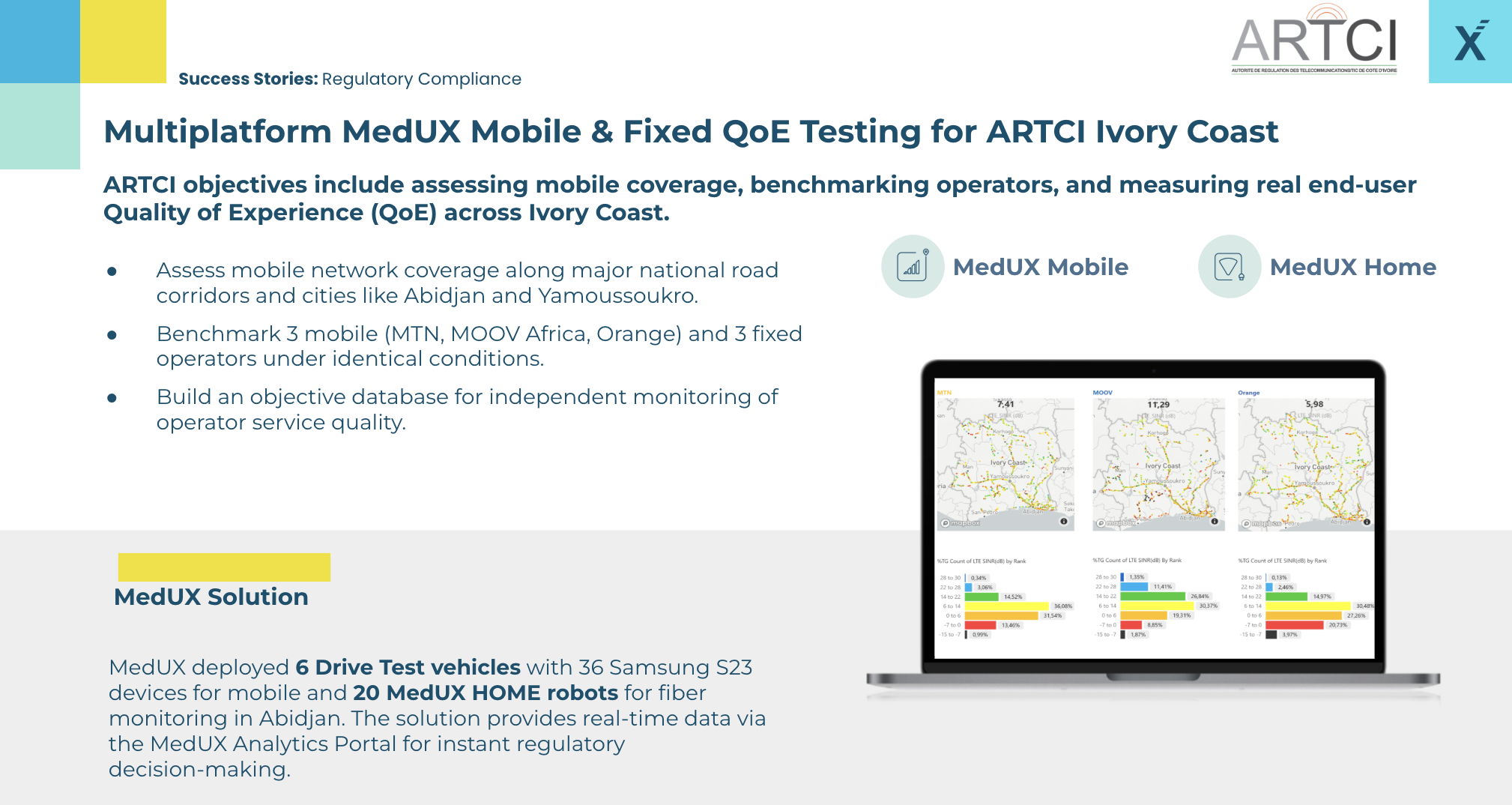
The solution enabled the measurement of mobile and fixed networks, different technologies, and multiple digital services from an end-to-end perspective. The architecture presented included data collection through active and passive methods, processing in the MedUX Cloud, and analytics visualization to support technical analysis and regulatory decision-making.
As part of this broader measurement ecosystem, the project also includes a standalone application for end users: CISpeed – Test de débit ARTCI. Available on Google Play, the app allows citizens to measure the real quality of their Internet connection through quick and advanced tests, including download and upload speed, latency, jitter, packet loss, web browsing performance, video streaming quality, and service-readiness indicators for everyday digital uses. This app-based layer strengthens the user-centric dimension of the project by enabling ARTCI to complement controlled field and fixed measurements with insights closer to the citizen experience, supporting transparency, public awareness, and a more complete understanding of connectivity quality across Côte d’Ivoire.
This multi-platform approach enables regulators to compare operators under consistent conditions, identify performance gaps, and build an objective knowledge base for service quality monitoring.
Supporting ARTCI’s regulatory objectives
The project responded to several key objectives defined by ARTCI to strengthen network quality supervision in Côte d’Ivoire.
For mobile networks, the objective was to assess coverage and signal quality in key cities and national road corridors, compare operators under equivalent conditions, measure the real user experience, and build an independent and standardized database for regulatory monitoring.
For fixed networks, the project aimed to continuously monitor broadband quality, compare operators under the same measurement protocol, assess user experience across services such as streaming, web browsing, social media, and gaming, and create a robust baseline for future regulatory decisions.
This approach allows regulators to go beyond a purely technical view of the network and move towards supervision focused on services and real digital experience.
A large-scale measurement deployment
The project presented at ITU included a high-volume mobile and fixed measurement deployment.
On the mobile side, MedUX supported a national measurement campaign using drive-test vehicles and smartphones configured to evaluate mobile network experience across major cities and national road corridors. The campaign generated generated millions of mobile tests and radios samples.
On the fixed side, MedUX deployed 20 MedUX HOME robots in permanent locations in Abidjan to continuously measure fibre connections, both via Ethernet and Wi-Fi. The project generated millions of fixed broadband tests during the analysed period.
In addition to these controlled measurement methods, the standalone CISpeed app adds a complementary participation layer by allowing end users to test their own connectivity conditions. This reinforces the project’s ability to connect technical network monitoring with the real experience perceived by citizens in their daily digital activities.
This combination of field measurements, permanent monitoring, and app-based user measurements provides regulators with a comprehensive view: broad geographic visibility into mobile coverage and performance, continuous and controlled assessment of fixed broadband experience, and complementary insight into how connectivity performs from the citizen perspective.
Measuring services, not just networks
One of the most relevant aspects of the project is that measurement was not limited to traditional network KPIs.
In addition to indicators such as coverage, throughput, latency, radio performance, and IP performance, the project incorporated experience metrics associated with specific services: web browsing, video streaming, voice, gaming, social media, and other digital services relevant to end users.
This approach is especially important because a network may show acceptable technical values and still fail to deliver an adequate experience for certain services.
For example, a user may have coverage but experience slow web page loading. A connection may reach a certain speed but still suffer interruptions during streaming. Or a network may provide connectivity but not guarantee a suitable experience for low-latency services such as gaming or interactive applications.
By incorporating QoE indicators, regulators can assess not only whether the network works, but whether it fulfils its main purpose: enabling users to access digital services with sufficient quality.
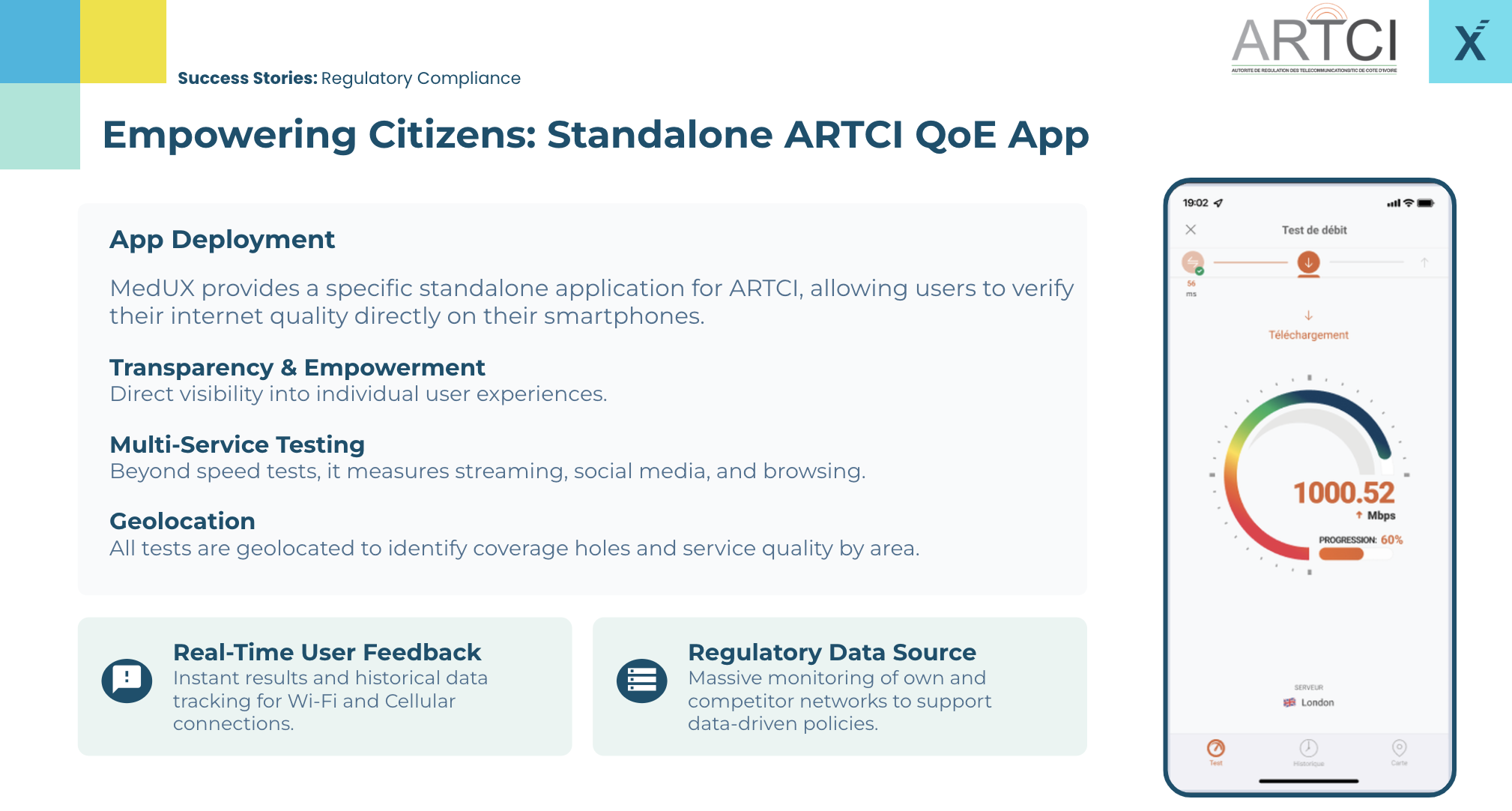
The standalone app reinforces this service-oriented perspective by helping users understand what their connection can actually support, from web browsing and online gaming to audio and video calls, music streaming, and video content in different quality levels. In this way, measurement becomes easier to understand for citizens while remaining valuable for regulatory analysis.
From technical data to regulatory intelligence
MedUX’s value proposition does not end with data collection.
The data collected by MedUX devices is transmitted to the cloud, where it is processed, harmonized, and transformed into actionable indicators. The results are then visualized through the MedUX Analytics Portal, enabling access to network quality and user experience insights from anywhere.
For a regulator, this represents an important shift in how telecommunications quality is supervised.
Instead of relying only on periodic audits, operator reports, or isolated measurements, the regulator can access an independent evidence base to understand how networks perform,
where quality differences exist, which services show the greatest variability, and how performance evolves over time.
This type of information can support decisions related to compliance, transparency, investment prioritization, consumer protection, and public policies aimed at more meaningful connectivity.
By combining professional-grade measurements with a standalone citizen-facing app, ARTCI can also strengthen public transparency and digital awareness. Citizens gain a practical tool to evaluate their own Internet experience, while regulators can promote a more evidence-based conversation around connectivity quality and service performance.
A scalable model for regulators in Africa
The ARTCI case demonstrates how a QoS/QoE measurement framework can become a strategic tool for African regulators.
As markets continue to advance in fibre, 4G, 5G, FWA, cloud services, and convergent networks, quality measurement must evolve at the same pace.
It is no longer enough to know where coverage exists. It is necessary to understand what experience users receive, how digital services perform, and where gaps remain between urban areas, national corridors, less dense regions, and high-demand environments.
The model presented by MedUX combines several key elements:
- Mobile and fixed network measurement.
- Field campaigns and continuous monitoring.
- Technical QoS KPIs and QoE experience metrics.
- Benchmarking under comparable conditions.
- Advanced analytics and results visualization.
- Independent evidence for regulatory supervision.
- A standalone app layer to engage end users, capture real-world connectivity feedback,
- A methodological foundation for future public transparency and crowdsourcing initiatives.
This type of approach helps regulators transform large volumes of data into practical intelligence to improve the quality of telecommunications services.
Better connectivity starts with better visibility
MedUX’s participation in the ITU event in Zambia reinforces our commitment to independent, objective, and user-centric network measurement.
The project developed with ARTCI in Côte d’Ivoire shows how regulators can rely on QoS and QoE data to strengthen supervision, promote transparency, and support more reliable, inclusive, and citizen-oriented connectivity.
We thank ITU for creating this valuable space for technical and regulatory dialogue, and ARTCI for trusting MedUX to contribute to the development of an advanced measurement ecosystem in Côte d’Ivoire.
As networks evolve towards more complex, convergent, and service-oriented architectures, the ability to measure real user experience will become increasingly important.
Because better connectivity starts with better visibility.
Want to know more?
Don’t forget to follow us on social media and subscribe to our newsletter to receive the latest updates and news.
Follow us on:


About MedUX
MedUX is a global leader in Quality of Experience testing and monitoring, helping telecom operators, regulators, governments and digital enterprises understand how users actually experience fixed, mobile and Wi-Fi networks.
Through a multi-platform measurement ecosystem — including mobile and fixed probes, apps, SDKs, crowdsourcing and advanced analytics — MedUX provides end-to-end visibility into network and service performance, supporting benchmarking, optimization, regulatory compliance and customer experience improvement across markets worldwide.
Explore the Latest from MedUX

QoE Revolution in Africa: Meaningful Quality to Accelerate Digital Transformation
Speed isn’t enough anymore. In Africa’s fast-evolving digital landscape, it’s the Quality of Experience (QoE) that determines whether connectivity is truly meaningful. From seamless video calls to smooth app usage and reliable streaming, users demand more than just access—they demand performance…