
How MedUX Measures Converged QoE: One Framework, Multiple Data Sources

MedUX is launching a unique converged benchmarking framework to evaluate seamless connectivity experiences, representing the next generation of telecom benchmarking for recognising excellence across fixed and mobile networks, as well as wired and wireless connectivity.
As operators increasingly deliver integrated connectivity as part of the same service ecosystem, network leadership can no longer be assessed through a single technology or measurement approach. For users, the boundaries between these networks matter less than the ability to browse, stream, play, communicate and work reliably wherever they connect.
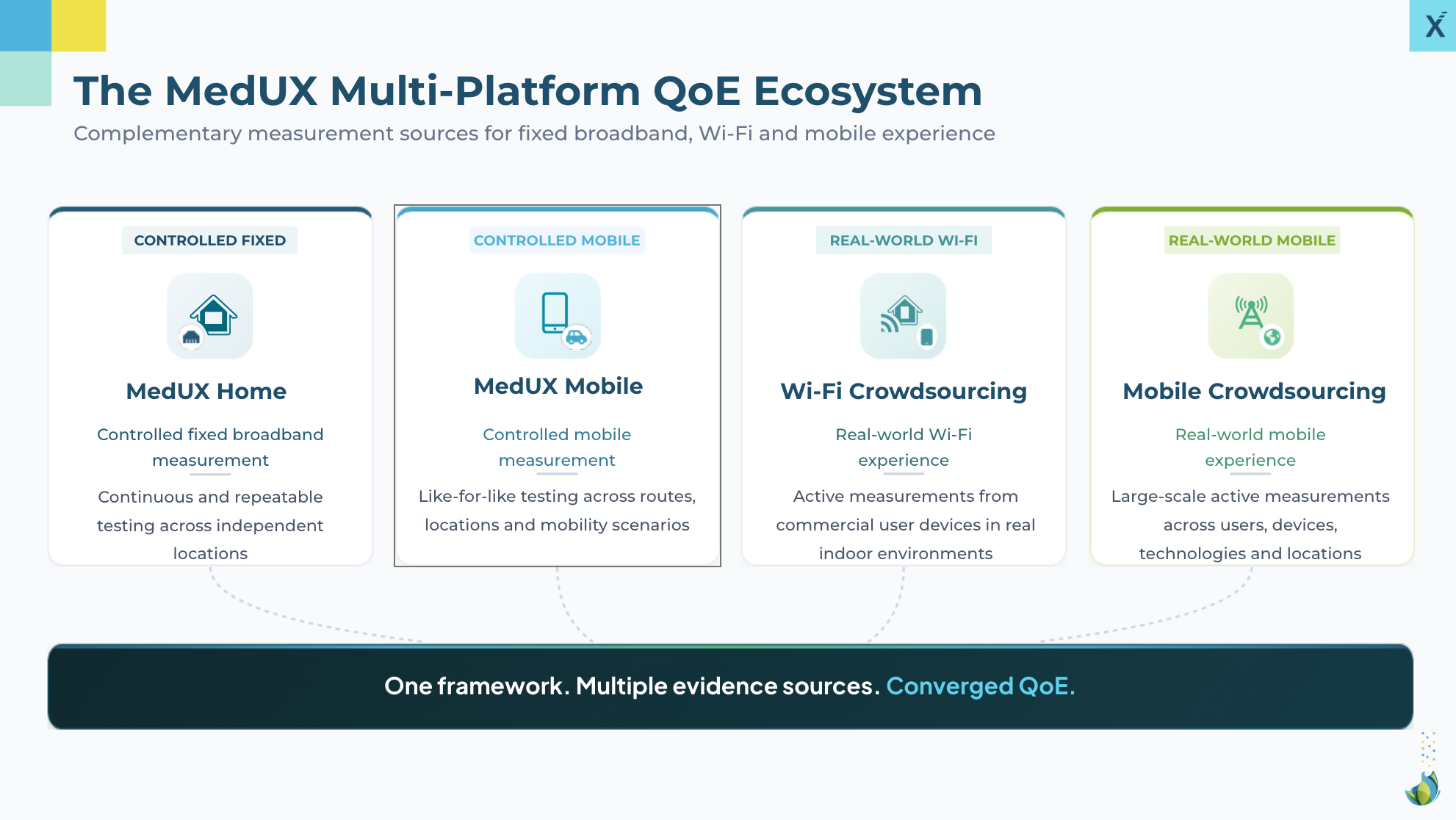
To address this challenge, MedUX introduces the industry's first truly multi-platform Converged Quality of Experience (QoE) framework, capable of combining complementary evidence sources—including fixed probes, mobile probes, Wi-Fi crowdsourcing and mobile crowdsourcing—under one transparent and consistent methodology. Rather than relying on a single collection model, the framework adapts to the most representative evidence available in each market while ensuring comparability, transparency and statistical robustness.
MedUX is introducing the industry's first truly multi-platform converged QoE framework. The MedUX Converged QoE Awards framework can combine multiple evidence sources (fixed probes, mobile probes, Wi-Fi crowdsourcing and mobile crowdsourcing) under a single transparent methodology.
The MedUX framework brings together complementary measurement perspectives to evaluate the complete connectivity ecosystem experienced by users. It measures not only network performance, but also the quality of the digital services delivered across fixed broadband, Wi-Fi and mobile connectivity, providing operators, regulators and consumers with a more comprehensive and actionable view of network experience.
Each award publication specifies the sources used, the networks and services assessed, the measurement period, the scoring configuration and the evidence supporting the recognition.
This framework builds on MedUX's established methodologies for controlled mobile network benchmarking, fixed broadband QoE benchmarking and advanced mobile crowdsourcing benchmarking.
Designed to evolve alongside the telecommunications industry, the framework provides a future-ready foundation for recognising emerging dimensions of network quality beyond traditional connectivity metrics. Future editions will progressively introduce new assessment areas, including AI Readiness, CDN Resilience and other innovations that reflect how operators shape and how users experience next-generation digital services.
What is converged QoE?
Converged Quality of Experience, or converged QoE, is the quality users receive across fixed broadband, in-home Wi-Fi and mobile connectivity when accessing everyday digital services.
It goes beyond measuring whether a connection is available or how fast it can transfer data. It evaluates whether network capacity translates into a responsive, reliable and satisfying experience when users browse websites, stream video, use social media, access cloud services or play online games.
The MedUX approach assesses this experience through a combination of:
- Controlled and repeatable network measurements.
- Real-world measurements from commercial user devices.
- Technical Quality of Service indicators.
- Service-level Quality of Experience indicators.
- A transparent scoring framework that preserves visibility into every measurement source.
One multi-platform ecosystem, complementary views of experience
MedUX combines proprietary probes, software agents, crowdsourced measurements, analytics and QoE scorecards to evaluate mobile, fixed broadband, Wi-Fi and digital service experience.
The principal data collection sources supporting the awards framework are:
- MedUX Home fixed broadband probes.
- MedUX Mobile probes.
- Wi-Fi and mobile crowdsourcing.
Each source answers a different measurement question. Together, they provide a broader view than any isolated network indicator or collection method.
MedUX Home probes: continuous and controlled fixed broadband measurement
Fixed broadband performance can be measured through autonomous MedUX Home probes connected to the router by Ethernet.
The probes execute a scheduled battery of tests throughout the day, including peak and off-peak periods. Unlike tests carried out specifically in response to a perceived problem, autonomous testing captures performance systematically whether or not a user notices an issue.
The panel is designed according to the market under assessment. Probe locations are distributed to reflect relevant geographical and population patterns, broadband technologies and commercial service profiles.
For a typical fixed broadband benchmark, MedUX deploys approximately 45 independent measurement locations per operator. The panel is designed to provide a statistically representative view of the defined market cluster, reflecting relevant geographical and population patterns, broadband technologies and commercial service profiles. The resulting confidence level and margin of error are calculated for each deployment and disclosed as part of the benchmark methodology.
The reference cluster, geographical coverage, technology mix, service-profile distribution and expected statistical precision are therefore evaluated for each deployment and disclosed in the award-specific methodology.
Because every probe executes the same scheduled test suite repeatedly, the panel combines independent geographical observation points with consistent temporal coverage across peak and off-peak periods. Repeated measurements strengthen the assessment of consistency over time, but they are not treated as additional independent locations.
The Ethernet connection provides visibility into the performance delivered by the fixed access network before variables from the in-home wireless environment are introduced, such as Wi-Fi interference, router placement or individual device capabilities.
This source helps answer two fundamental questions:
How effectively is the fixed network delivering the broadband service?
How consistently does that service perform across different hours and network load conditions?
MedUX Mobile probes: controlled mobile QoE across targeted scenarios
MedUX Mobile probes provide controlled and repeatable measurements across defined routes, locations and service areas.
Equivalent commercial devices, configurations, test protocols and target servers are used across the operators and technologies being compared. This supports like-for-like assessment and reduces variations caused by differences in measurement equipment or test execution.
Tests may be performed from static locations, dedicated vehicles, public transport, indoor environments or other mobility scenarios relevant to the project.
Mobile probes are particularly valuable when a benchmark requires:
- Detailed comparison of strategically important areas or routes.
- Equivalent testing conditions across operators.
- Evaluation of newly deployed technologies.
- Specific analysis of 5G, 5G Standalone, spectrum bands or network configurations.
- Additional evidence in locations where real-world datasets do not yet provide sufficient coverage or granularity.
Because the campaign is configurable, mobile probes can focus on the latest network developments even when adoption among commercial users remains limited.
This source helps answer:
How do mobile networks compare when measured under equivalent conditions?
How effectively do they deliver connectivity and digital services in the locations, technologies and mobility scenarios that matter to the assessment?
Wi-Fi crowdsourcing: measuring experience inside the connected environment
A strong fixed broadband connection does not always result in a strong experience on the user's device.
Wi-Fi performance can be affected by router capabilities, frequency bands, signal conditions, interference, device characteristics and the configuration of the home or indoor environment.
MedUX collects Wi-Fi measurements through lightweight software agents and SDKs embedded in commercial applications. This makes it possible to observe the experience delivered directly to real devices under everyday conditions.
Active measurements reproduce common user activities such as web browsing, data transfer, video streaming or online gaming. Tests are scheduled according to predefined configuration and eligibility rules and are executed when the necessary device and network conditions are met.
Unlike tests launched specifically in response to a perceived problem, scheduled testing provides a more systematic view of performance and reduces the self-selection effect associated with testing mainly when users believe something is wrong.
Wi-Fi crowdsourcing therefore connects fixed access performance with the experience that actually reaches the device.
It helps answer:
What experience do users receive after the fixed connection passes through the real in-home or indoor Wi-Fi environment?
Mobile crowdsourcing: measuring connectivity wherever users go
Mobile crowdsourcing gathers active measurements from commercial devices across real locations, technologies, devices and network conditions.
The lightweight MedUX SDK schedules tests that simulate common digital activities using standardised configurations. These measurements can be enriched with contextual information collected at the time of the test, including connectivity type, signal conditions, cellular technology, device characteristics, location and relevant network changes.
Measurements can therefore reflect:
- Urban and rural areas.
- Indoor and outdoor environments.
- Peak and off-peak periods.
- Stationary and mobility scenarios.
- Different device and operating-system combinations.
- Cellular technologies including 4G, 5G Non-Standalone and 5G Standalone.
The result is a large-scale view of how mobile services perform where users actually live, work and travel.
This source helps answer:
How does the mobile experience vary across the real footprint of each operator?
How consistently are digital services delivered across locations, devices, technologies and network conditions?
For more information don’t hesitate to contact us!
Don’t forget to follow us on social media and subscribe to our newsletter to receive the latest updates and news.
Follow us on:


About MedUX
MedUX is the leading Quality of Experience (QoE) company, providing comprehensive and innovative solutions for measuring the performance of fixed, mobile, and TV telecommunications networks for telecom operators, governments, and digital enterprises. With a focus on delivering grand scale, end-to-end network, and service visibility, MedUX leverages real-time customer perspective data and advanced analytics to ensure quality and regulatory compliance, while also offering valuable insights for optimizing networks and improving customer experiences. With a presence in over 25 countries across Europe, America, Africa, and the Middle East, and monitoring over 60 operators worldwide, MedUX’s patented technology and expertise make it a trusted partner for improving the digital experiences of customers everywhere.