
In Romania, the fastest 5G finishes last on quality of experience

What does it mean when the fastest 5G in a market belongs to the network with the lowest experience score?
MedUX's Q3 2026 Mobile Network Experience Benchmark in Romania evaluates Orange, DIGI and Vodafone beyond traditional speed metrics, using crowdsourcing measurements from real-user devices.
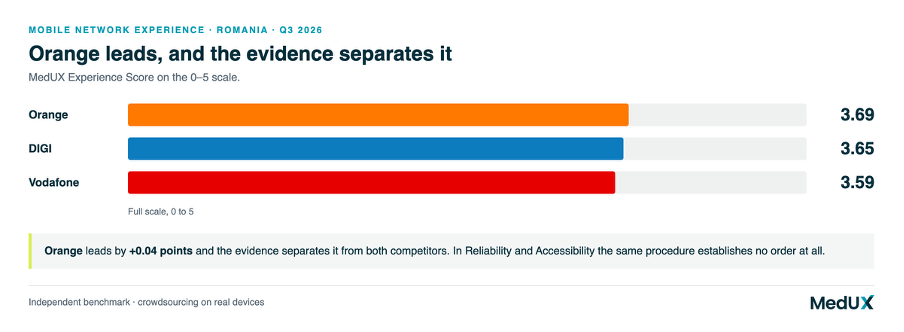
The benchmark identifies Orange as the statistically differentiated leader in overall experience, with a MedUX Experience Score of 3.69 out of 5. DIGI scores 3.65 and Vodafone 3.59.
The three operators sit within a band of 0.10 points out of five. The evidence separates the leader from both of the others. And the network with the fastest 5G in the country is the one with the lowest overall score.
A narrow lead can still be a conclusive one
Orange's advantage over the next operator is +0.04 points. Differences that small are usually where a benchmark stops being reliable, so what matters is not the size of the gap but whether the evidence supports it.
MedUX recognises a differentiated leader only when its advantage over every relevant competitor is supported at the 95% confidence level. Orange's overall advantage meets that test, and so do its advantages in Value for Speed and Streaming. In Reliability and Accessibility, the same procedure reaches the opposite verdict, because the networks are too close for any order to be established. A table of scores on its own does not show the difference between the two cases.
Three networks, three different strengths
Orange does not top the ranking by dominating one dimension. It tops it by being at or near the top of every dimension at once, which is what a composite score rewards.
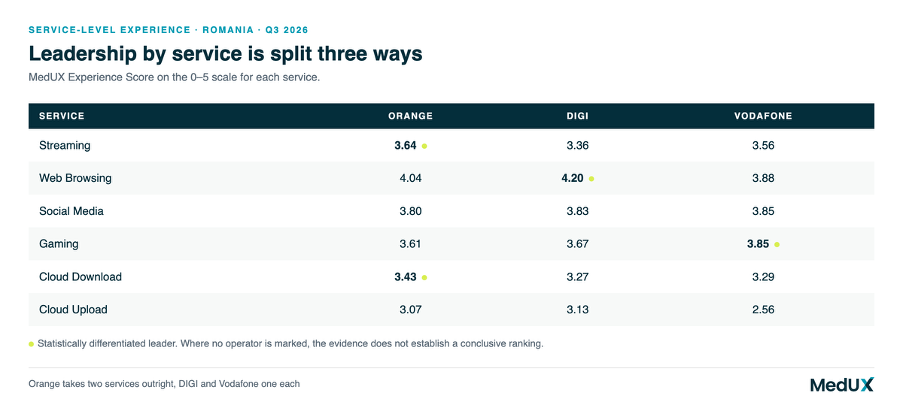
Orange is the differentiated leader in the overall score, in Value for Speed (3.28), in Streaming (3.64) and, at service level, in Cloud Download (3.43). DIGI is the differentiated leader in Data & OTT (3.98) and in Web Browsing (4.20). Vodafone leads Gaming (3.85), the widest service-level gap in the market, and still records the lowest overall score.
Differentiated leadership appears in four of the six scoring dimensions and four of the six services, and it is shared between all three networks.
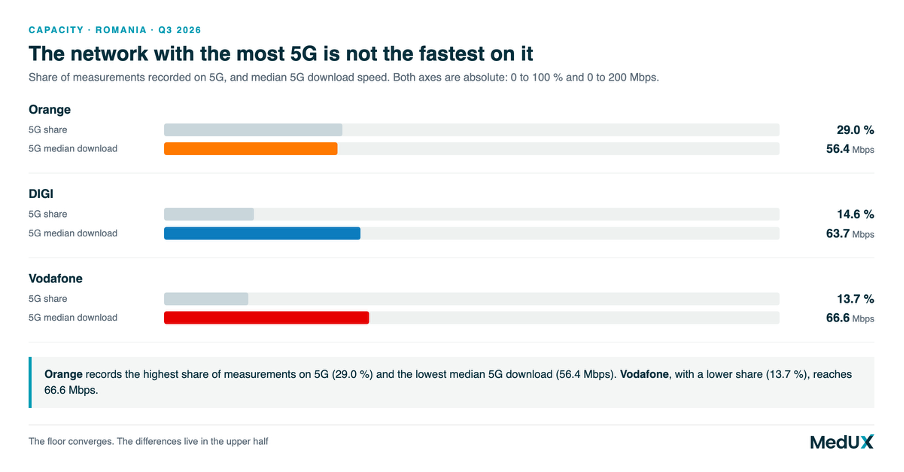
Raw capacity points the other way. Vodafone has the fastest 5G download in the market and the lowest overall score. Peak capacity describes what a network can reach. The composite score describes what its users typically get.
The gaps are not all the same size
Not every service separates the networks by the same distance, and the leaders are not the same ones.
The widest distance between the first and second operator appears in Gaming (+0.18), where Vodafone is the differentiated leader, followed by Web Browsing (+0.16), where DIGI is. The narrowest is Social Media, at +0.02, and there the evidence establishes no order at all. Vodafone has the highest number in that row, but the procedure does not confirm it as a lead. Cloud Upload is the same case.
Video shows the same thing. The share of playbacks served in 4K ranges from 45.1% to 36.4%, and the operator with the fastest 5G download is not the one serving the highest share. Resolution is set along the delivery path, not by raw capacity alone.
The network with the most 5G is not the fastest on it
Capacity still matters, but it does not settle the experience on its own. Romania shows why.
Orange records the highest share of measurements on 5G, 29.0% of its tests and 47.3% among handsets that support 5G, yet the lowest median 5G download, 56.4 Mbps. Vodafone, with a lower 5G share of 13.7%, reaches 66.6 Mbps at the median. Greater observed 5G presence does not translate into faster downloads.
That is 5G on its own, and it is not how the scoring works. Across all technologies, Orange has the highest median of the three, 28.1 Mbps, and Cloud Download is not scored on the median in any case. It counts how often a download is fast enough to do the job, and Orange clears that bar more often than either competitor. Its 5G figure sits lower because it carries twice as much of its traffic there, across a wider range of places.
Moving from 4G to 5G still multiplies the median download by between 2.5 and 3.1 times. But the 5G measured here is almost entirely non-standalone, with fewer than 0.01% of the quarter's 5G tests running on a standalone core, so these are gains in speed rather than in what standalone 5G enables.
How MedUX measured mobile experience in Romania
The benchmark draws on 3,434,239 active measurements and more than 919 million passive radio samples collected from 1 July to 30 September 2026 through MedUX crowdsourcing on real-user devices. Active measurements were taken on each operator's own SIM and mobile network. Wi-Fi and roaming sessions were excluded. Radio samples provide network context and quality control and do not enter the Experience Score.
Three networks are assessed because three is what the quarter had. Telekom Romania Mobile Communications was absorbed into Vodafone Romania with legal effect on 30 June 2026, the day before this period begins, and measurements still carrying legacy Telekom identifiers are excluded rather than assigned to either buyer.
Results are then standardised geographically against the Eurostat Census 2021 population grid (1 km², version 2.2) through a hierarchical estimator. The figures therefore describe the market rather than the places where measurement happens to concentrate.
Two kinds of speed figure appear in this benchmark and they are not interchangeable. Both come from the same measurements and the same population weighting, but the figures quoted here are medians and percentiles, while the separate speed awards are decided on the mean. On a distribution with a tail this long, the mean sits far above the median, which is also why published averages from other sources are not comparable with the figures above.
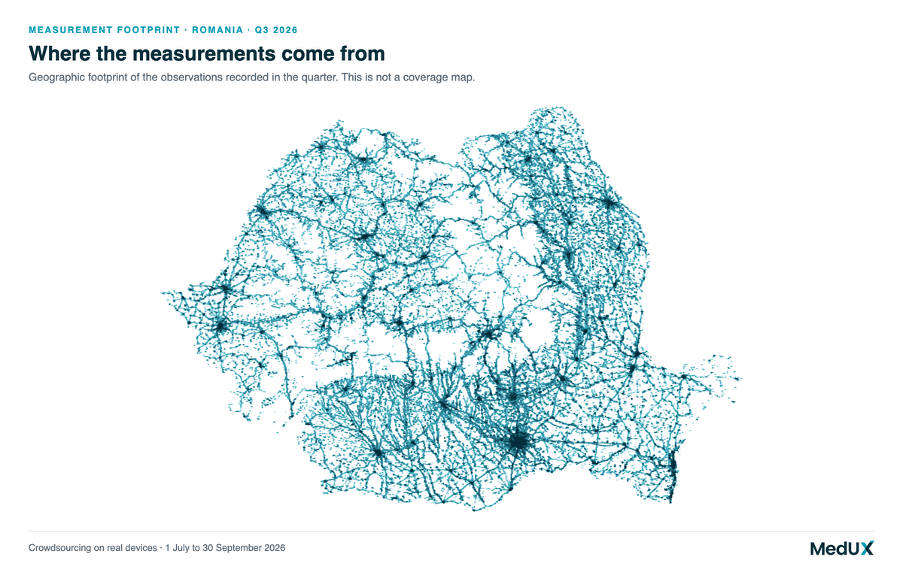
The results describe experience in the observed measurement footprint. They are not a coverage or network-availability assessment, and geographic standardisation does not make the voluntary crowdsourcing sample probabilistically representative of the population.
Why service-level QoE, and not only throughput
Quality of Service metrics such as throughput and latency remain essential, but they do not explain the full customer experience.
Mobile users experience networks through applications and services, from watching video and browsing to gaming, social media and cloud platforms. The Romanian results show why a single network indicator is not enough. The operator with the greatest observed 5G share does not have the highest median 5G download speed, and the operator serving the highest share of 4K playbacks is not the fastest on download.
That is why MedUX combines network-performance indicators with service-level QoE metrics and a common scoring framework, applied equivalently to every operator evaluated.
See the full Romania Q3 2026 results
Explore the Romania Q3 2026 Mobile Network Experience Snapshot for a visual overview of the experience scoring, results by service, statistical leadership and the geographic measurement footprint.
The snapshot includes:
- The national MedUX Experience Score and its statistical status
- The full experience scoring by dimension
- Service-level results for streaming, web browsing, social media, gaming and cloud
- What each dimension measures
- The measurement footprint of the period
- Scope, method and the criterion applied for statistical leadership
Download the Romania Q3 2026 Mobile Network Experience Snapshot
Methodology
For more information on MedUX's approach to mobile crowdsourcing and service-level QoE benchmarking:
Explore MedUX's Mobile QoE Crowdsourcing Benchmarking Methodology
The Romania Q3 2026 benchmark applies version 2026.1 of that methodology, which takes as its reference the good practice set out in ETSI TR 103 559.
Don’t forget to follow us on social media and subscribe to our newsletter to receive the latest updates and news.
Follow us on:


About MedUX
MedUX is the leading Quality of Experience (QoE) company, providing comprehensive and innovative solutions for measuring the performance of fixed, mobile, and TV telecommunications networks for telecom operators, governments, and digital enterprises.
With a focus on delivering grand scale, end-to-end network, and service visibility, MedUX leverages real-time customer perspective data and advanced analytics to ensure quality and regulatory compliance, while also offering valuable insights for optimizing networks and improving customer experiences.
With a presence in over 25 countries across Europe, America, Africa, and the Middle East, and monitoring over 60 operators worldwide, MedUX's patented technology and expertise make it a trusted partner for improving the digital experiences of customers everywhere.