
Introducing MedUX Solve: from QoE data to network actions, faster

Ask better. Prioritize faster. Solve what matters.
Operators don’t have a data problem, they have a time-to-insight problem.
Across mobile and fixed networks, we already collect massive, real-world evidence of customer experience: active tests, passive signals, device context, radio conditions, geolocation, and service KPIs. The challenge is turning that ocean of measurements into clear answers and actionable priorities, fast enough to keep up with network changes and customer expectations.
That’s why we’re introducing MedUX Solve, MedUX Intelligent Assistant: a conversational AI solution designed to help telecom operators consume QoE data at scale, extract insights in seconds, and identify practical levers to improve network performance and customer experience.
Why MedUX Solve and why now?
he industry is moving from measuring “coverage on paper” to proving experience in practice: what users actually get, where they connect, and how digital services perform in real life. This shift is also visible in the growing focus on experience KPIs, comparability, and evidence-driven decisions.
At the same time, telecom organizations are being asked to do more with less: accelerate analysis, prioritize investment, reduce trouble tickets, and improve customer satisfaction, all while networks become more complex (5G evolution, Wi-Fi generations, new devices, new traffic patterns, vendor fragmentation).
Solve is built to meet that reality: make massive QoE evidence usable, explainable, and action-oriented for network quality, engineering and operations teams.
What is MedUX Solve?
Solve is an AI assistant connected to MedUX’s QoE data foundation, combining our crowdsourcing at global scale and robots active testing data, to help teams interact with true QoE massive information using natural language.
Instead of spending hours building queries, filtering dashboards, and stitching multiple views together, Solve is designed to answer questions like:
- “Where did video streaming QoE degrade this week, and why?”
- “Compare 5G throughput rural versus urban and breakdown by operator”
- “Which areas should we prioritize first to improve experience?”
MedUX already operates a large-scale QoE measurement ecosystem (crowdsourcing + active testing + contextual enrichment) and delivers insights via dashboards and APIs; Solve adds a new, more intuitive consumption layer on top of that foundation. This represents a fundamental paradigm shift in how operations, engineering teams and other interest groups interact with massive QoE data, moving from static report consumption to dynamic, conversational insight extraction tailored to immediate operational needs.
What MedUX Solve helps teams do?
Inspired by the same “problem-first” framing we apply to our QoE solutions, Solve focuses on removing friction between data → insight → action:
- From dashboards to decisions: reduce the time it takes to move from “something looks off” to “here’s what to do next.”
- Faster prioritization: identify the locations, technologies, services, or device segments that drive the biggest QoE impact.
- Easier cross-team alignment: give NOC, RAN, and management a shared, plain-language interpretation of what the data is saying.
- Operational scalability: help teams extract value from “always-on” monitoring rather than one-off campaigns.
The data foundation behind MedUX Solve
MedUX Solve is designed to build on MedUX’s crowdsourcing and active measurement approach, where embedded technology enables non-intrusive active tests and creates ground-level QoE evidence without disrupting user experience.
Our crowdsourcing footprint and KPI framework are built to capture a 360° view of experience, combining active and passive measurements, and enriching them with network, device, and contextual signals. Data is described as being securely stored, anonymized, enriched, and processed into actionable dashboards and reports (including API access).
This matters because “AI” is only as useful as the data it can reliably reason over. Our solution is designed to stay anchored to measurable evidence and operator workflows.
How MedUX Solve works
While the solution’s capabilities will evolve, the experience is simple:
- Ask a question in natural language (e.g., streaming QoE, coverage holes, before/after change).
- Understand: Solve returns the “where / what / why”, tying results to QoE KPIs and context (technology, device, location, time).
- Prioritize: it highlights the areas/segments with the highest impact on experience.
- Act: it helps you work on practical next steps (investigation paths, drill-down dimensions, and optimization focus), aligned with operations and engineering usage.
MedUX Solve significantly reduces daily troubleshooting efforts by providing dynamic visualizations (charts, tables, maps, widgets, etc.) and powerful insights, all tailored to the specific query and response.
Question → map/insight
The User Asks: "Give me the list of the top 10 worst regions per throughput in Spain for the last week."
Solve Responds: Instant output listing the worst-performing regions and key metrics.
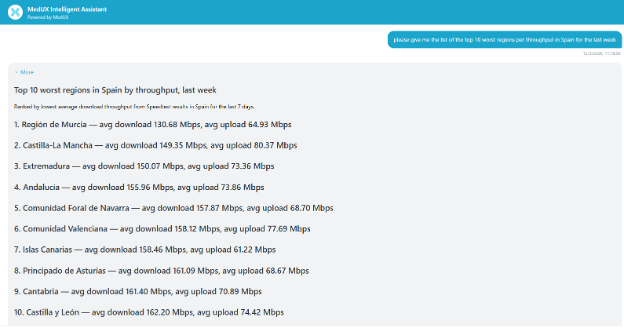
Prioritization list + "next steps
The User Investigates: "Is there a potential area causing the degradation in Murcia?” to understand potential reasons of degradation.
The assistant Responds: Yes, rural Murcia appears to be pulling the regional average down, highlighting in seconds that rural areas in the region require attention

Map showing identified rural areas
The User asks Solve to provide a map highlighting the problematic areas
Solve Pinpoints: A map view highlighting the rural areas contributing most to the QoE degradation, ready for field investigation or network planning.

Use cases: from data to actions that matter
MedUX Solve is designed around the same high-value applications already central to MedUX’s QoE ecosystem: massive field-data monitoring (coverage holes, underserved areas, spectrum/bandwidth signals, and before/after assessments), plus optimization and planning support.
In practice, that means helping teams move faster on questions like:
- Coverage holes and consistency gaps that customers feel (not just what propagation models claim).
- 5G evolution tracking (e.g., real user exposure to capacity or capability layers).
- Service experience for streaming, gaming, web browsing, with the context needed to explain variance across cities, devices, and access technologies.
Example questions you can ask MedUX Solve
Experience degradation & anomalies
- “Where did video streaming QoE degrade in the last 7 days?”
- “Show the top 10 areas with increased buffering / slower start time.”
- “Which cities saw the biggest QoE drop during peak hours?”
Root-cause guidance
- “Is the degradation correlated with 5G → 4G fallback or specific bands?”
- “Which devices / OS versions show the worst experience?”
- “Is performance worse on Wi-Fi vs. mobile in the affected areas?”
Validation / before-after
- “Compare QoE before vs after the last optimization in [AREA].”
- “Did the change improve user experience consistently, or only off-peak?”
Planning & prioritization
- “Where should we prioritize investment to improve QoE the fastest?”
- “Which underperforming zones affect the largest number of users?”
Trust by design: privacy-first, operator-ready
In telecom, trust isn’t a nice-to-have, it’s foundational.
MedUX crowdsourcing describes a non-intrusive, privacy-aware approach where tests run silently and data is stored and processed securely with anonymization and enrichment. MedUX Solve is being developed with that same philosophy: make insights easier to access without compromising data governance expectations.
Want early access to MedUX Solve?
If you’d like to see MedUX Solve in action and explore how conversational QoE analytics can accelerate your service assurance workflows:
to discuss early access and your priority use cases.
or
Follow us on:


About MedUX
MedUX is the leading Quality of Experience (QoE) company, providing comprehensive and innovative solutions for measuring the performance of fixed and mobile telecommunications networks for telecom operators, governments, and digital enterprises. With a focus on delivering grand scale, end-to-end network, and service visibility, MedUX leverages real-time customer perspective data and advanced analytics to ensure quality and regulatory compliance, while also offering valuable insights for optimizing networks and improving customer experiences. With a presence in over 50 countries across Europe, America, Africa, and the Middle East, and monitoring over 60 operators worldwide, MedUX’s patented technology and expertise make it a trusted partner for improving the digital experiences of customers everywhere
Explore the Latest from MedUX

Inbound Roaming at the 2026 World Cup: What Device-Level Data Reveals About the Visitor’s Network
Inbound Roaming at the 2026 World Cup: What Device-Level Data Reveals About the Visitor’s Network
Millions of international visitors arrived in the United States, Mexico and Canada for the 2026 World Cup. But did they experience the same mobile network as the people who live there?
MedUX…

Honduras Mobile Network Experience in Q1 2026: Performance and QoE by Operator
Honduras’ mobile experience in Q1 2026 reflects a market where competitive leadership depends strongly on the service being measured. Claro shows clear strength in speed, application loading and streaming startup, while Tigo stands out in latency-sensitive and responsiveness indicators.
…

Dominican Republic’s Mobile Network Experience in Q1 2026: 5G, Performance and QoE by Operator
Dominican Republic’s mobile experience in Q1 2026 reflects a market where network leadership depends strongly on the dimension being measured. Claro shows clear strength in speed and several service-level indicators, Altice stands out in general network responsiveness and upload performance,…