
Inbound Roaming at the 2026 World Cup: What Device-Level Data Reveals About the Visitor’s Network

Inbound Roaming at the 2026 World Cup: What Device-Level Data Reveals About the Visitor’s Network
Millions of international visitors arrived in the United States, Mexico and Canada for the 2026 World Cup. But did they experience the same mobile network as the people who live there?
MedUX measured what visitors actually received from the device itself, and the answer differs significantly from one host country to another.
Using passive real-user data across hundreds of thousands of devices together with more than four million controlled active speed and video tests, MedUX compared international visitors with residents nationwide and around key World Cup locations.
The result is a different way to look at inbound roaming Quality of Experience (QoE): not from coverage maps or network-side indicators, but from the connection the visitor actually gets.
Same tournament. Three host countries. Three very different visitor experiences.
Inbound roaming in a real three-country mega-event
The 2026 World Cup created an unusual real-world network experiment.
For six weeks, a large and concentrated population of foreign SIMs moved across the United States, Mexico and Canada following the tournament. That gave MedUX the opportunity to answer a question that network-level data alone can easily miss:
What mobile connection does an international visitor actually experience?
The analysis combines two complementary perspectives: passive measurements showing how devices connect to networks, and controlled active tests measuring speed and video performance.
And importantly, the analysis is nationwide in each host market, not limited to the World Cup host cities.
What mobile experience did World Cup visitors get?
Compared with residents using the same networks, the national picture is striking:
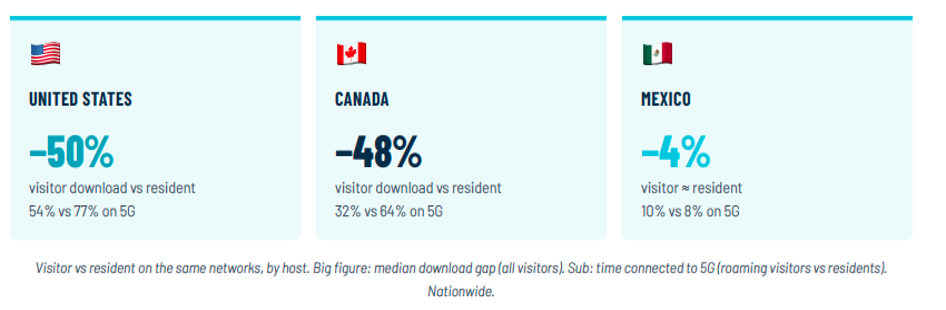
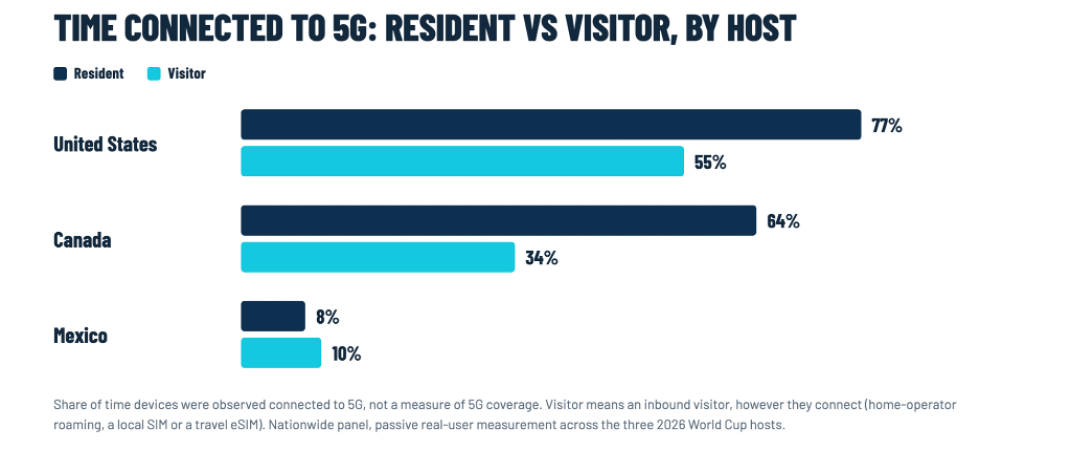
- United States: visitor median download speed was 50% lower than the resident level. Roaming visitors were connected to 5G 54% of the time, compared with 77% for residents.
- Canada: visitor median download speed was 48% lower, while roaming visitors were connected to 5G 32% of the time versus 64% for residents.
- Mexico: visitor download speed was only 4% below the resident level, while 5G connection share was also close to parity: 10% for roaming visitors versus 8% for residents.
These are two different measurements and should not be conflated. Download performance tells one part of the story. The share of time devices are observed connected to 5G tells another.
Mexico is the only host where visitors and residents were close on both.
The counterintuitive result is the United States. It recorded both the highest resident 5G connection share and the fastest resident download speed of the three markets, 77% and 53.8 Mbps, yet still showed one of the widest visitor gaps.
A stronger local network does not automatically mean an international visitor receives the same experience.
How did international visitors connect: roaming, local SIM or travel eSIM?
This is an important part of the visitor connectivity story.
From the device perspective, international visitors generally connected in one of three ways:
Home-operator roaming: the visitor keeps their usual SIM and mobile plan and connects through a host-country network under their home operator’s roaming arrangement.
Local SIM or eSIM: the visitor purchases connectivity directly from a mobile operator in the country they are visiting.
Travel eSIM: the visitor uses an international eSIM service, such as Airalo, Holafly or a similar provider, rather than relying exclusively on their home operator’s roaming service.
Despite the growth of eSIM alternatives, traditional home-operator roaming remained by far the dominant connection method during the World Cup.
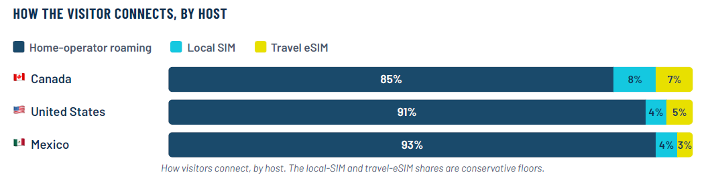
The local-SIM and travel-eSIM shares should be considered conservative floors in the MedUX measurement methodology.
Canada shows the highest adoption of alternative connectivity: approximately 15% of visitors combined used a local SIM or travel eSIM. In the US, the equivalent share was around 9%, and in Mexico around 7%.
Yet the main message is the scale of roaming itself.
Between 85% and 93% of visitors continued using their home operator while abroad.
That means the Quality of Experience delivered to most international visitors depends not only on the host network, but also on the roaming conditions associated with the visitor's home operator, origin, device and service environment.
And connection type matters.
In the United States and Canada, traditional roaming showed the largest observed 5G connection-share gap against residents. Visitors using local SIMs or travel eSIMs were observed closer to the resident benchmark.
In other words, the connectivity choice a traveller makes can influence the mobile experience they receive after landing.
Download the full report: for the Visitor´s Network
Why does visitor origin matter?
Roaming is not one uniform experience.
Visitors arrive with different operators, different devices and different roaming arrangements. The MedUX data shows that observed 5G connection share can vary significantly depending on where the visitor comes from.
In fact, some visitor groups showed relatively consistent 5G behaviour even when roaming in different host countries.
That is an important clue.
It means that the host network alone does not explain the visitor experience. Origin and roaming conditions are important dimensions of the outcome, alongside the visited network and device environment.
It also helps explain why three countries hosting the same tournament produced such different aggregate results.
The sharpest finding appears in the same kilometre
National averages have an unavoidable limitation: visitors and residents are not always standing in the same places.
MedUX therefore repeated the analysis at approximately 1 km resolution, comparing roaming visitors with residents located inside the same area.
The stadium results make the visitor gap much harder to dismiss.
Around World Cup stadiums, roaming visitors were observed connected to 5G substantially less often than nearby residents:
- United States: 40% for roaming visitors versus 82% for residents.
- Canada: 32% versus 65%.
- Mexico: 8% versus 17%.
This is particularly revealing in Mexico.
At national level, roaming visitors and residents were close to parity. At stadium level, once the comparison controls for location, a clear difference appears.
And visitors were not simply losing connectivity.
MedUX did not observe a higher service-drop rate among visitors than among nearby residents at the US venues tested. They were connected, but more often through 4G rather than 5G.
That distinction matters for operators assessing major-event connectivity and roaming QoE.
Is the visitor 5G gap entirely a network issue?
No.
Device mix is another important factor.
In the United States, roaming visitors carried a higher share of 4G-only devices than residents. When MedUX restricted the analysis to 5G-capable devices, the difference narrowed substantially.
Approximately half of the US visitor-resident 5G gap can be associated with device mix, while the remaining difference persists in the like-for-like comparison.
Mexico shows the opposite device pattern, with residents carrying more 4G-only handsets.
This is also why 5G connection share should not be interpreted as a direct measure of 5G coverage.
It measures how often devices were actually observed connected to 5G. Roaming conditions, device capability, network behaviour and service factors can all influence that outcome.
The gap is measurable. But its causes are multidimensional.
Why is inbound roaming QoE so difficult to see?
The international visitor sits in a telecom measurement blind spot.
They are not a normal subscriber of the visited operator, so they can be underrepresented in its conventional customer-experience reporting.
At the same time, they are no longer physically using their home operator's radio network.
Network-level performance data provides valuable context, but on its own it may not fully capture the conditions experienced by a real device carrying a foreign SIM and operating under a specific roaming arrangement.
That is where independent, user-side measurement becomes especially valuable.
Instead of asking only how the network performs, it allows the industry to ask:
What did this type of user actually experience on that network?
It also makes it possible to compare populations inside the same geographic area, control for device capability and analyze how the experience changes by visitor origin and connection type.
Why roaming QoE matters for operators
Inbound roaming is more than a technical connectivity issue.
It is part of the customer relationship.
For a home operator, the experience customers receive while travelling can influence satisfaction and retention. For the visited network, inbound roaming forms part of the wholesale value chain. And for both sides, the rapid growth of travel eSIMs and alternative connectivity creates another competitive dimension.
The World Cup data makes that tension visible.
Traditional roaming remained dominant, but a meaningful minority of visitors had already moved to local SIMs or travel eSIMs, particularly in Canada and among specific visitor origins.
Persistent roaming-QoE gaps can therefore increase the relevance of alternative connectivity options and make roaming quality an increasingly important consideration for customer retention, roaming-partner strategy and value capture.
For regulators and public stakeholders, there is another dimension. During a global event, a country's connectivity experience is being evaluated not only by residents, but by millions of international guests.
Those visitors deserve to be visible in the data too.
What does the full MedUX Visitor’s Network report reveal?
The results above are only part of the analysis.
The Visitor’s Network: North American Connectivity goes deeper into the mechanisms behind the visitor experience, including:
- Visitor origin versus host country and how roaming performance varies between traveller groups.
- How visitors connect through traditional roaming, local SIMs and travel eSIMs.
- 5G connection share by connection type.
- Stadium, airport and downtown comparisons.
- Same-area analysis at approximately 1 km resolution.
- Travel-eSIM and local-SIM adoption by visitor origin.
- The role of 4G-only and 5G-capable device mix.
- Download and video experience.
- The implications for operators, roaming partnerships and the inbound-roaming value chain.
- MedUX's independent customer-side measurement methodology.
Want to see the complete visitor connectivity picture across the United States, Canada and Mexico?
Download the full report: for the Visitor´s Network
Frequently asked questions about inbound roaming and visitor connectivity
What is inbound roaming?
Inbound roaming occurs when a customer from another country connects to a local mobile network while continuing to use their home operator's SIM and mobile service.
How did most international visitors connect during the 2026 World Cup?
Most visitors remained on home-operator roaming. MedUX observed home-operator roaming shares of 85% in Canada, 91% in the United States and 93% in Mexico. Local SIMs and travel eSIMs accounted for the remaining observed connections.
What is the difference between a local SIM and a travel eSIM?
A local SIM or eSIM is obtained from an operator in the country being visited. A travel eSIM is an international connectivity product designed for travellers and can provide access across one or several destinations without requiring a conventional local mobile subscription.
Did World Cup visitors receive the same 5G experience as residents?
Not always. Nationwide, roaming visitors were observed connected to 5G considerably less often than residents in the United States and Canada. Mexico was close to parity nationally, although a clear visitor-resident difference emerged around stadium areas.
Does lower 5G connection share mean poor 5G coverage?
No. 5G connection share is not equivalent to coverage. It describes how often a device was observed connected to 5G and can be affected by roaming arrangements, device capabilities, the network and other service factors.
Why should telecom operators measure roaming QoE?
Because roaming customers can experience a network differently from residents. Independent, device-level measurement helps operators identify those differences, evaluate roaming partners, improve customer experience and understand the competitive impact of alternatives such as travel eSIMs.
Don’t forget to follow us on social media and subscribe to our newsletter to receive the latest updates and news.
Follow us on:


About MedUX
MedUX is the leading Quality of Experience (QoE) company, providing comprehensive and innovative solutions for measuring the performance of fixed, mobile, and TV telecommunications networks for telecom operators, governments, and digital enterprises. With a focus on delivering grand scale, end-to-end network, and service visibility, MedUX leverages real-time customer perspective data and advanced analytics to ensure quality and regulatory compliance, while also offering valuable insights for optimizing networks and improving customer experiences. With a presence in over 25 countries across Europe, America, Africa, and the Middle East, and monitoring over 60 operators worldwide, MedUX’s patented technology and expertise make it a trusted partner for improving the digital experiences of customers everywhere.
Explore the Latest from MedUX

Honduras Mobile Network Experience in Q1 2026: Performance and QoE by Operator
Honduras’ mobile experience in Q1 2026 reflects a market where competitive leadership depends strongly on the service being measured. Claro shows clear strength in speed, application loading and streaming startup, while Tigo stands out in latency-sensitive and responsiveness indicators.
…

Dominican Republic’s Mobile Network Experience in Q1 2026: 5G, Performance and QoE by Operator
Dominican Republic’s mobile experience in Q1 2026 reflects a market where network leadership depends strongly on the dimension being measured. Claro shows clear strength in speed and several service-level indicators, Altice stands out in general network responsiveness and upload performance,…

MedUX Presents its QoS and QoE Measurement Project with ARTCI at ITU Zambia
Objective measurement of Quality of Service and Quality of Experience is becoming a key tool for regulators seeking to improve connectivity, transparency, and network performance.
MedUX participated in the ITU Workshop on Telecommunication Quality of Service, Quality of Experience and…